







Water-Soluble Fertilizer for Banana: How to Choose Grades for Fertigation
Water-soluble fertilizer for banana lets you feed the crop through drip in small doses that follow each growth stage, and in trials this gave more fruit from less fertilizer and water than soil-applied fertilizer. The best water-soluble fertilizer for banana is the one that dissolves cleanly in your water, matches the growth stage and costs […]

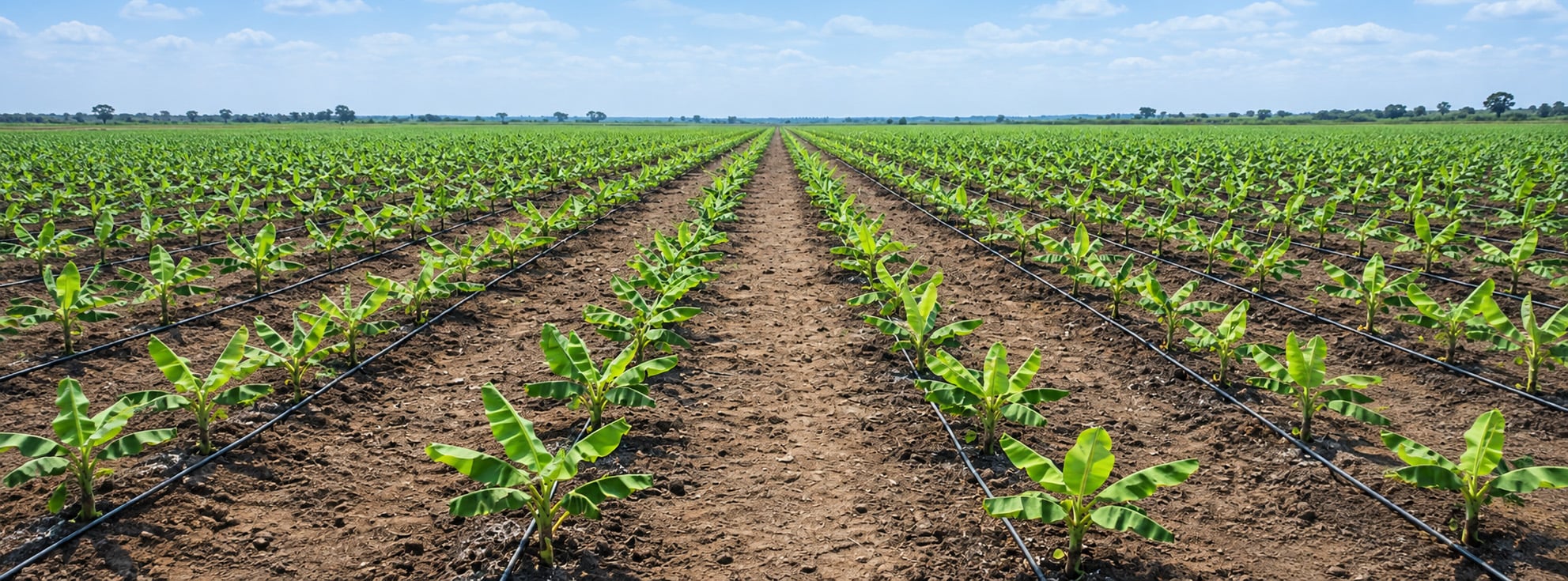

Water-soluble fertilizer for banana lets you feed the crop through drip in small doses that follow each growth stage, and in trials this gave more fruit from less fertilizer and water than soil-applied fertilizer. The best water-soluble fertilizer for banana is the one that dissolves cleanly in your water, matches the growth stage and costs the least per kilogram of nutrient. This guide covers why water-soluble fertilizers pay off, how premium grades compare with cheaper soluble products, what to check before you buy, and which grade fits each stage. It builds on our guide to fertilizer for banana plants.
What counts as a water-soluble fertilizer for banana
Two groups of products go through banana drip systems. Fully water-soluble specialty grades include NPK grades with trace elements, potassium nitrate, monopotassium phosphate (MKP), monoammonium phosphate (MAP) and calcium nitrate. Several conventional fertilizers also dissolve well: urea, ammonium sulfate, potassium chloride (muriate of potash) and potassium sulfate are all listed as suitable for applying to banana through irrigation, with phosphoric acid as a liquid P source (Robinson & Galán Saúco, 2010). The difference lies in purity, how fast and completely they dissolve, the nutrient forms they carry and the price.
Why use water-soluble fertilizers for banana
Water-soluble fertilizers are what make fertigation possible, and fertigation outperforms soil-applied fertilizer on almost every measure banana trials have taken.
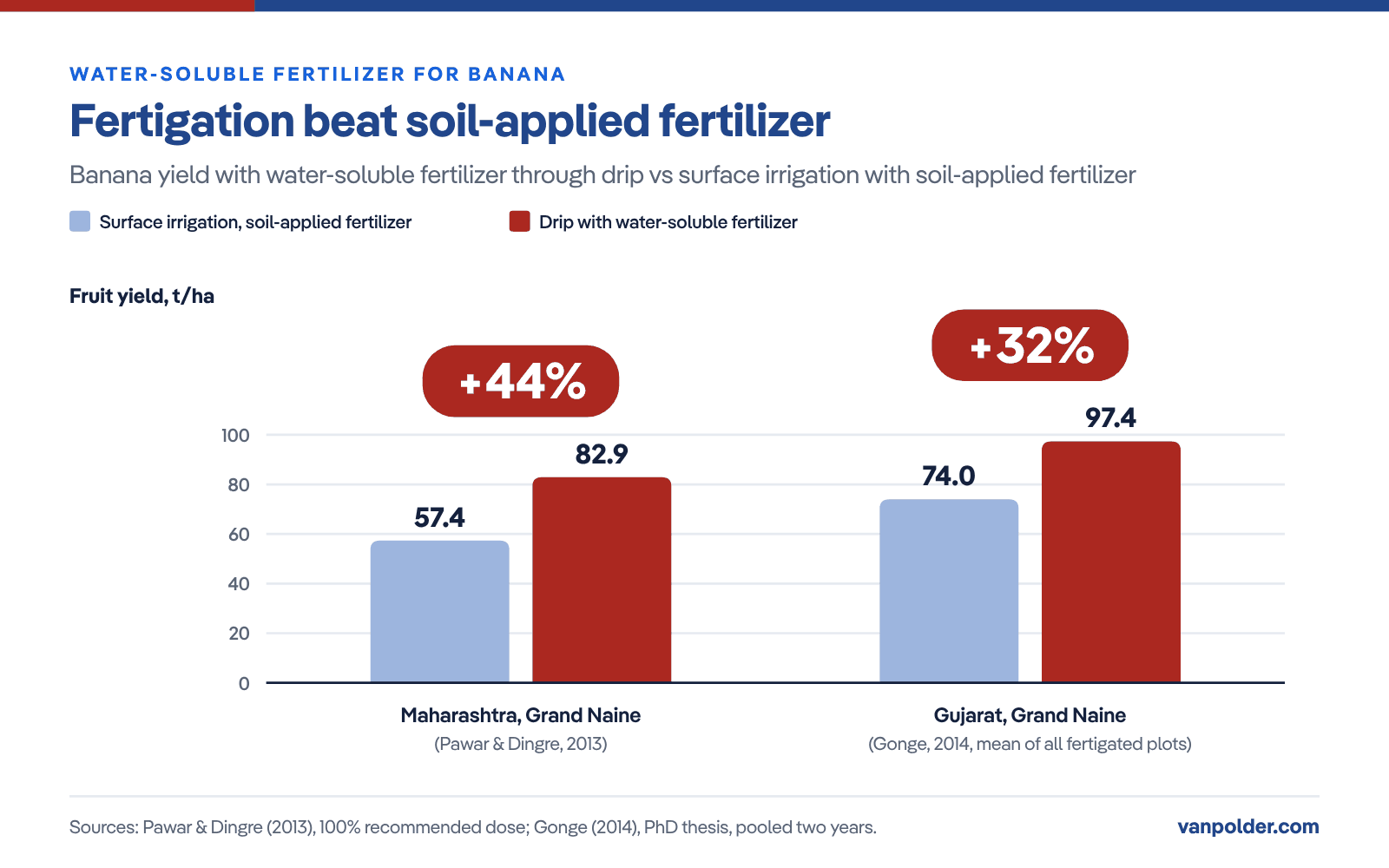
- More fruit. In Grand Naine in Maharashtra, a stage-based drip program with water-soluble fertilizer gave 82.9 t/ha against 57.4 t/ha with surface irrigation and soil-applied fertilizer (Pawar & Dingre, 2013). In Gujarat, every fertigated treatment out-yielded surface irrigation with soil-applied fertilizer: 97.4 t/ha on average against 74.0 t/ha (Gonge, 2014).
- Less fertilizer for the same yield. Fertigation at 75% of the recommended dose yielded as much as 100% and gave the best benefit:cost ratio (Abraham et al., 2025). Efficient fertigation can cut annual N and K rates by up to 25% (Weinert & Simpson, 2016).
- Less water. Drip fertigation used 52% less water than surface irrigation (Pawar et al., 2017). Drip applies water at about 95% efficiency (Robinson & Galán Saúco, 2010).
- Feeding that follows the crop. Nitrogen does not build up in the plant, so it is best given little and often, and fertigation allows weekly or even daily N (Robinson & Galán Saúco, 2010). With soluble P and K as well, the whole program can follow the stage shares instead of one or two large soil doses.
- Heavier bunches than soil-applied P and K. On the same drip system, supplying P and K as water-soluble fertilizer gave heavier bunches than applying them to the soil: 16.3 vs 15.7 kg (Pawar et al., 2017) and 28.4 vs 27.7 kg (Gonge, 2014).
Fully water-soluble grades or cheaper soluble fertilizers?
The open question is whether premium, fully water-soluble grades pay compared with cheaper fertilizers applied through the same drip system. Two trials compared them directly:
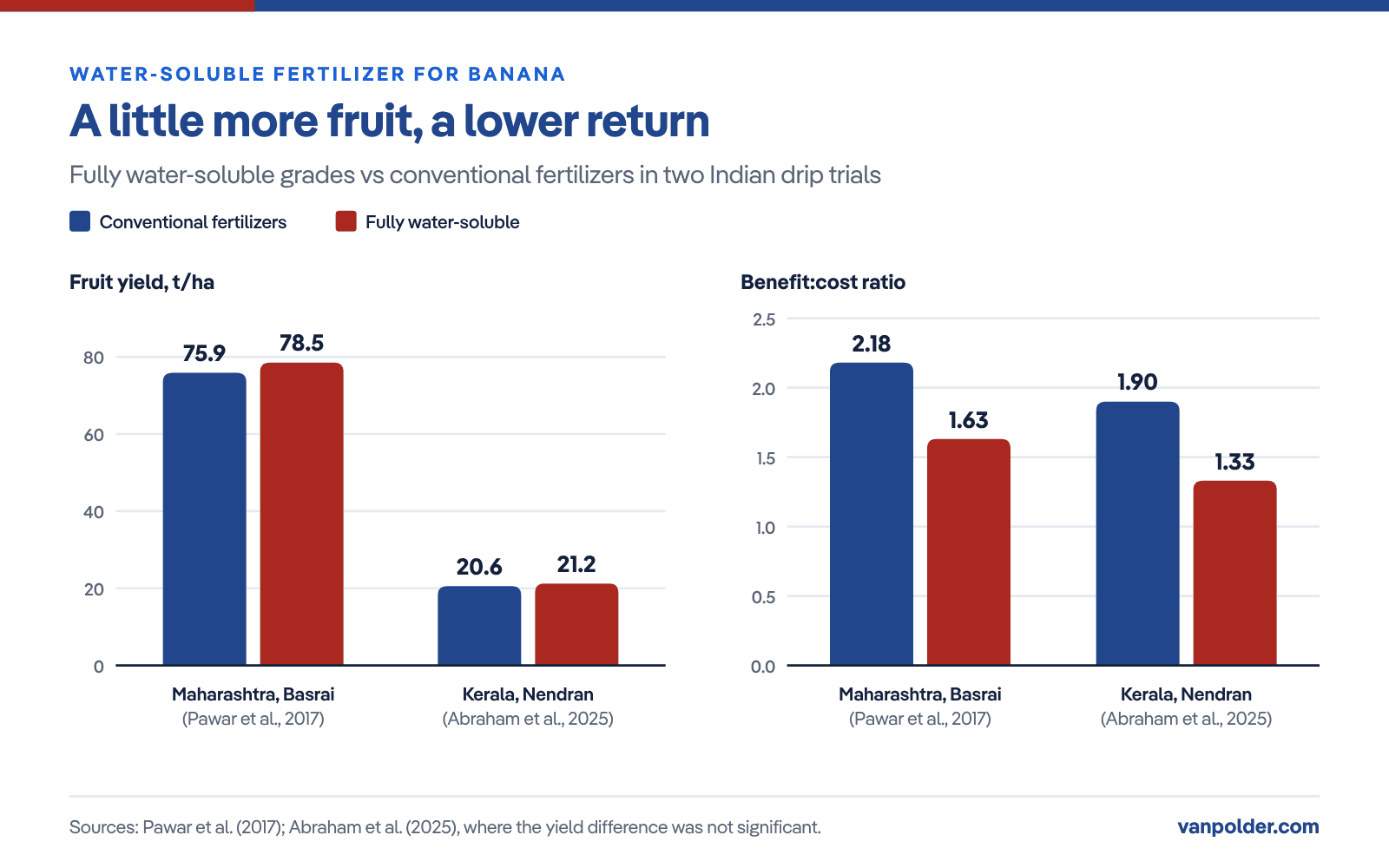
- In Maharashtra, fully water-soluble grades through drip gave 78.5 t/ha against 75.9 t/ha where only N went through the drip and P and K were applied to the soil. The water-soluble fertilizers cost Rs 52,000/ha against Rs 12,310/ha, so the net benefit:cost ratio fell from 2.18 to 1.63 (Pawar et al., 2017).
- In Kerala, Nendran fertigated for three years with common fertilizers (urea, ammonium phosphate sulfate and muriate of potash) yielded the same as with high-priced soluble fertilizers (MAP, potassium nitrate and urea): 20.6 against 21.2 t/ha, a difference that was not significant. The common fertilizers cost about a tenth as much per kg, and the benefit:cost ratio was 1.90 against 1.33 (Abraham et al., 2025).
A PhD thesis trial on Grand Naine in Gujarat found the same pattern: heavier bunches with water-soluble fertilizers, higher net returns with routinely used fertilizers (Gonge, 2014).
Read these results as price results. Indian conventional fertilizers are cheap, and the fruit in the Maharashtra trial was valued at Rs 3,000 per tonne (Pawar et al., 2017). By our calculation from that trial’s figures, the extra 2.6 t/ha would have covered the extra fertilizer cost only at about five times that fruit price. Where bananas sell for more, where the price gap between grades is smaller, or where conventional products leave residue in your lines, the sums change. Work them out with your own prices.
Premium grades also earn their place for reasons a yield trial doesn’t measure: one clean product in place of several, chloride-free potassium where water is salty, trace elements in the same tank and a known nitrogen form.
What to check before you buy
| Check | Why it matters in a banana drip system | What to look for |
| Solubility in cold water | Fertilizers differ widely in how much dissolves, and nitrogen fertilizers cool the tank as they dissolve, which lowers solubility further (Agriculture Victoria, 2023) | Use the solubility at 10 °C, not room temperature; potassium sulfate dissolves far less than potassium chloride (about 12 vs 35 kg per 100 L at 20 °C) (Robinson & Galán Saúco, 2010) |
| Insoluble residue | Granular fertilizers suit fertigation only if they are soluble and free of impurities (Agriculture Victoria, 2023) | A clear solution in a jar test; cloudiness or sediment after 24 hours means the product is not suitable (Agriculture Victoria, 2023) |
| Chloride | Chloride from potassium chloride can build up over time; irrigation water above 600 ppm Cl is unsuitable for banana (Robinson & Galán Saúco, 2010) | Chloride-free potassium (potassium nitrate, potassium sulfate, MKP) where your water or soil is already salty |
| Nitrogen form | Under drip, urea and ammonium nitrate gave faster growth and higher yields than potassium nitrate as the only N source, linked to a steadier nitrate and ammonium balance (Israeli et al., 1985) | Grades that state nitrate, ammonium and urea N separately, so you know what you are applying |
| Calcium compatibility | Calcium reacts with phosphate and sulfate and settles out (Agriculture Victoria, 2023) | Calcium products that go in their own tank, apart from phosphates and sulfates |
| Organic additives | Many organic products (seaweed, humic acids) have low solubility and can cause sediment and clogging (Agriculture Victoria, 2023) | Jar-test any organic product with your water before injecting it |
| Price per kg of nutrient | Grades differ in analysis, so the bag price alone misleads | Divide the price by the kg of N, P2O5 or K2O in the bag and compare like with like |
Sources as cited in each row.
Most of these checks come down to one test. Mix the fertilizer with your irrigation water at the injection ratio, shake it and leave it for 24 hours; if it does not mix, or turns cloudy or forms sediment, don’t inject it (Agriculture Victoria, 2023). Sediment in the water itself is the main cause of emitter clogging, and a more concentrated fertilizer solution makes it worse (Zhang et al., 2026), so filter well and don’t overconcentrate.
Best water-soluble fertilizer for banana by growth stage
Banana needs N and P early and K in growing shares from flower initiation through bunch filling. A crop of about 50 t/ha removes 189 kg N and 778 kg K per hectare in its fruit (Lahav & Turner, 1983, and Lahav, 1995, in Robinson & Galán Saúco, 2010), so a balanced grade alone falls short later in the cycle. The table matches grade types to the stage shares in our banana fertilizer schedule, which gives the weekly splits.
| Stage (plant crop) | Nutrient focus | Grade type that fits | Van Polder options |
| Establishment, 0–2 months | N and P in small doses, some K | Balanced or high-P NPK | WSF NPK 19-19-19+TE, WSF NPK 13-40-13+TE |
| Vegetative growth, 3–6 months | Peak N and P; K rising | Balanced NPK; MKP for P and K without extra N | WSF NPK 19-19-19+TE, WSF NPK 20-20-20+TE, MKP 0-52-34 |
| Flower initiation to shooting, about 5–8 months | K at its highest share; N continues | High-K NPK or potassium nitrate | WSF NPK 15-5-40+TE, Potassium nitrate PURE |
| Bunch filling, shooting to harvest | K continues; N tapers; little or no P | Potassium nitrate or high-K NPK | Potassium nitrate PURE, WSF NPK 15-5-40+TE |
| Any stage, separate tank | Ca and Mg | Calcium magnesium nitrate | WSF CamagN |
Stage shares from Pawar & Dingre (2013) and Balamohan et al. (2015); timings for a Cavendish plant crop in the tropics. Product choice is matched to each grade’s label analysis.
Potassium nitrate supplies K and N at about 3 to 1, a ratio well suited to banana (Robinson & Galán Saúco, 2010). For choosing between potassium nitrate, potassium sulfate and muriate of potash, see potash for banana plants, and for potassium sources in general, our guide to potassium fertilizers. Feeding K before shooting is also the main nutrition lever in how to increase banana bunch weight.
Mixing water-soluble fertilizers for banana
As a rule of thumb, dissolve 100 kg of fertilizer in 500 L of water; with good agitation you can go to 1 part in 3 (Agriculture Victoria, 2023). Keep calcium products apart from phosphates and sulfates, because calcium nitrate is incompatible with phosphate and sulfate solutions (UC Agriculture and Natural Resources, n.d.). Most banana fertigation systems use two stock tanks for this reason; the tank-by-tank table is in our banana fertilizer schedule.
Water-soluble fertilizer for banana in the Philippines
The Philippine Code of Good Agricultural Practices for banana prefers drip and under-tree micro-irrigation to overhead sprinklers, asks that fertilizer be applied based on soil and/or leaf analysis, and requires records of each application (BAFS, 2013). Three local points affect which grades you buy:
- Potassium nitrate is a regulated product in the Philippines, so check availability with your distributor before you plan a program around it.
- Some Davao soils are rich in magnesium. A five-year plantation study found Mg dominating the soil exchange complex and heavier bunches where the soil K/Mg ratio was higher (Salibay & Salomez, 2009). Add Mg-containing grades only where leaf analysis shows a need.
- Acid soils are common in parts of Mindanao, down to pH 3.9 in the Jasaan series (Ohagan et al., 2023). On acid soils, nitrate sources with an alkaline reaction, such as calcium nitrate, should make up a significant part of the N supply (Agriculture Victoria, 2023).
Van Polder water-soluble fertilizers for banana
- WSF NPK 19-19-19+TE and WSF NPK 13-40-13+TE: urea-free NPK grades with trace elements, with N as nitrate and ammonium, for establishment and vegetative growth.
- WSF NPK 20-20-20+TE: a balanced NPK with nitrate, ammonium and urea N, for vegetative growth.
- MKP 0-52-34: phosphorus and potassium without nitrogen.
- WSF NPK 15-5-40+TE: a high-K NPK with trace elements, from flower initiation through bunch filling.
- Potassium nitrate PURE (13.6-0-46.2): chloride-free K with nitrate N.
- WSF CamagN (13.5-0-0+16CaO+6MgO): calcium and magnesium with nitrate N, for the calcium tank.
All are produced to Van Polder specifications. Follow the product label for rates and set nutrient rates from soil and leaf analysis.
FAQ
Is 19-19-19 good for banana?
Yes, for establishment and early vegetative growth, when the plant needs N and P. Later it supplies too little K: a banana crop removes about four times as much K as N in its fruit (Robinson & Galán Saúco, 2010), so switch to a high-K grade from flower initiation.
Which water-soluble fertilizer is best for banana flowering and bunch filling?
A high-K grade such as potassium nitrate or a 15-5-40 type NPK, because K takes its highest share of the program from flower initiation onward (Pawar & Dingre, 2013). Potassium nitrate’s K to N ratio of about 3 to 1 suits banana (Robinson & Galán Saúco, 2010).
Can I use muriate of potash through drip?
Yes. Potassium chloride is listed as suitable for fertigating banana and is the cheapest K source, but chloride can build up over time (Robinson & Galán Saúco, 2010). Where irrigation water is already high in chloride, use a chloride-free source.
How much water-soluble fertilizer can I dissolve in a stock tank?
A common rule is 100 kg in 500 L of water, or 1 part in 3 with good agitation. Use the solubility at 10 °C, because nitrogen fertilizers cool the tank as they dissolve (Agriculture Victoria, 2023).
Next step
Price your options per kilogram of nutrient, jar-test them with your own irrigation water, and set the stage program from a soil test and leaf analysis. For help choosing water-soluble grades for each stage, contact your Van Polder distributor.
Sources
-
- Abraham, M., Kurien, E.K., Joseph, S., Maria, D.M.S., Raj, N.G., Thomas, D. & Bhindhu, P.S. (2025). Response of banana variety Nendran (Musa spp.) under different sources and levels of nutrients in open field precision farming conditions. Journal of Tropical Agriculture 63(3): 99–105. https://doi.org/10.63599/JTA.2025.1555
- Agriculture Victoria (2023, updated 2026). Fertigation. Department of Energy, Environment and Climate Action, Victoria. agriculture.vic.gov.au
- Balamohan, T.N., Auxilia, J. & Sudha, R. (2015). Standardization of stage-wise requirement of nutrients in banana cv. Grande Naine (AAA). Journal of Horticultural Sciences 10(2): 165–171. jhs.iihr.res.in
- Bureau of Agriculture and Fisheries Standards (2013). PNS/BAFS 129:2013 Code of Good Agricultural Practices for Banana Production. Department of Agriculture, Philippines. ppssd.buplant.da.gov.ph
- Gonge, A.P. (2014). Comparative performance of water soluble and routinely used fertilizer in banana cv. Grand Naine under drip irrigation. PhD thesis, Navsari Agricultural University, Gujarat, India.
- Israeli, Y., Hagin, J. & Katz, S. (1985). Efficiency of fertilizers as nitrogen sources to banana plantations under drip irrigation. Fertilizer Research 8: 101–106. https://doi.org/10.1007/BF01048893
- Ohagan, J.M., Harnaiz, L.L.A., Nagal, C.J.C., Taylaran, R.D. & Gonzaga, A.B. Jr. (2023). Productivity of ‘Saba’ banana as influenced by different levels of NPK fertilizer under Jasaan soil series. Mindanao Journal of Science and Technology 21(1): 186–201. https://mjst.ustp.edu.ph/index.php/mjst/article/view/1516
- Pawar, D.D. & Dingre, S.K. (2013). Influence of fertigation scheduling through drip on growth and yield of banana in western Maharashtra. Indian Journal of Horticulture 70(2): 200–205. journal.iahs.org.in
- Pawar, D.D., Dingre, S.K. & Bhoi, P.G. (2017). Productivity and economics of drip-irrigated banana (Musa spp.) under different planting and fertigation techniques in subtropical India. Communications in Soil Science and Plant Analysis 48(4): 449–458. https://doi.org/10.1080/00103624.2017.1282505
- Robinson, J.C. & Galán Saúco, V. (2010). Bananas and Plantains, 2nd edition. Crop Production Science in Horticulture 19. CABI, Wallingford. ISBN 978-1-84593-658-7.
- Salibay, M.A.L. & Salomez, J.A. (2009). Banana fertilization at the FPO plantation: evaluation of soil and leaf analysis results. Southeastern Philippines Journal of Research and Development 18(2). https://ejournals.ph/article.php?id=9061
- UC Agriculture and Natural Resources (n.d.). Interactions which can cause precipitation. Maintenance of microirrigation systems. ucanr.edu
- Weinert, M. & Simpson, M. (2016). Subtropical banana nutrition: matching nutrition requirements to growth demands. NSW Department of Primary Industries. ISBN 978-1-74256-984-0. horticulture.com.au
- Zhang, Z., Ai, P., Zhang, C., Liu, W., Zang, W. & Tuoheti, T. (2026). Coupled effects of fertilizer and sediment on drip irrigation emitter clogging and its implications for sustainable water–fertilizer management. Sustainability 18: 4663. https://doi.org/10.3390/su18104663


Maharashtra has declared drought in 265 talukas after a weak monsoon, and grape growers in Nashik fear losing at least 40% of this season’s harvest. For anyone supplying fruit growers in India, the next few months are about keeping crops and vines alive and productive with very little water. At Van Polder, we believe drought […]

Denmark’s new nitrogen regulation starts on 1 January 2027, but vegetable growers and several fruit, berry and nursery crops will stay on today’s nitrogen norms for one more year. For anyone supplying high-value horticulture, this is a short pause, not a change of direction. At Van Polder, we believe nitrogen efficiency will matter more every […]
Retailers in the United States report that growers are trimming micronutrient spending this season, while tissue tests keep finding zinc, boron and manganese shortages. At Van Polder, we believe this is the wrong place to save, and the lesson applies to every market our partners serve. When nitrogen, phosphate and potash bills rise, micronutrient fertilizer […]
To increase banana bunch weight, build a large, healthy leaf canopy and good potassium reserves before the bunch emerges, keep water supply steady, and protect the leaves until harvest. Most of the bunch’s potential is set before shooting: the number of fruits depends on the leaf area the plant has when it initiates its flower […]
The right fertilizer for banana plants is the one that matches what the crop removes, what your soil already holds and the stage the plant is in. Banana takes up far more potassium than any other nutrient, followed by nitrogen and calcium, so K supply and timing decide much of the result. This guide covers […]
Potassium fertilizer replaces the potassium (K) your crop takes from the soil faster than the soil can release it. After nitrogen, potassium is the nutrient plants need in the largest amounts (Zörb et al., 2014), mainly to move water and sugars and to keep their cells working under stress. The common sources (muriate of potash, […]