







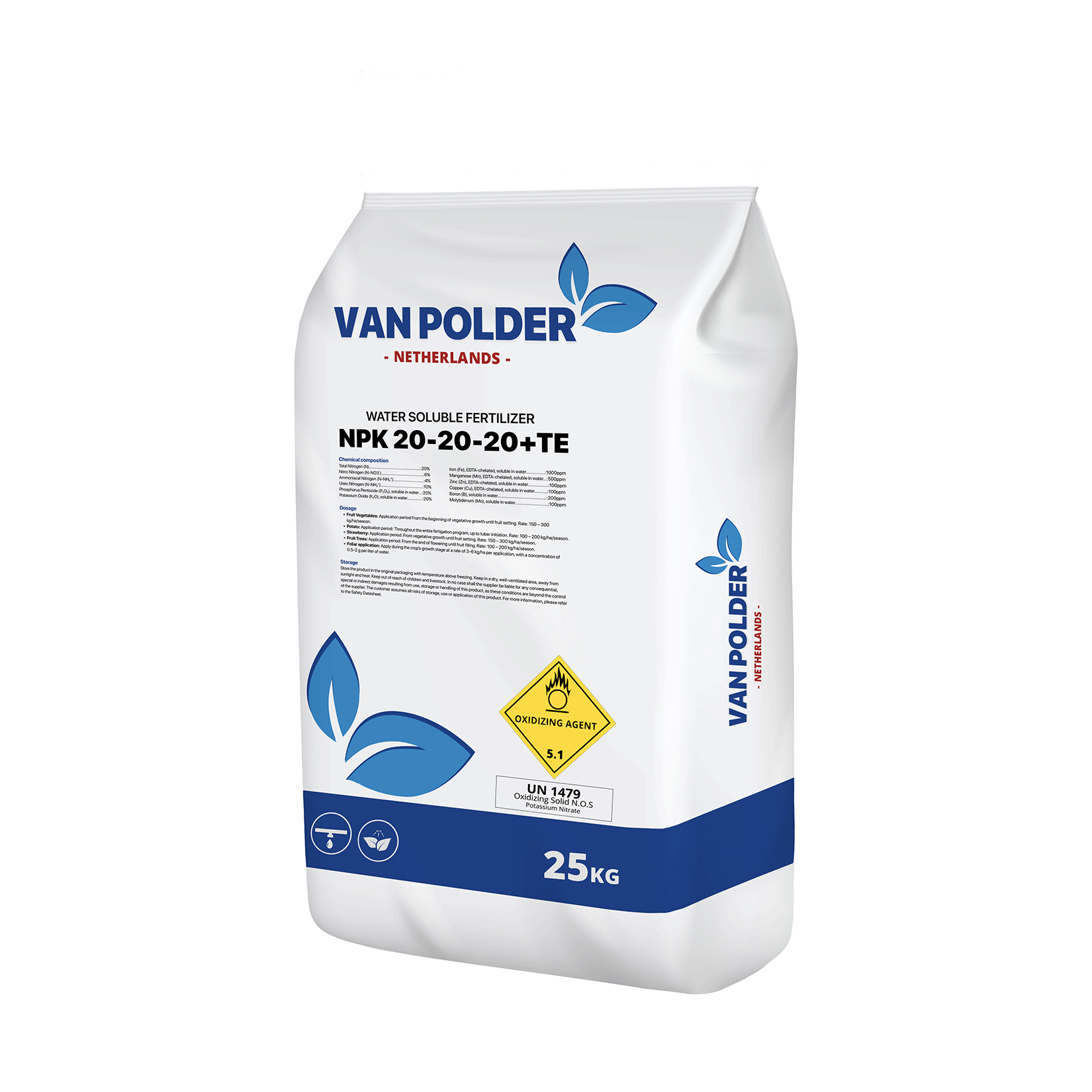
NPK 20-20-20+TE
| FUNCTIONS: | Balanced nutrition – Vegetative growth – General-purpose feeding – Micronutrient supply |
| FOR: | Greenhouse and open-field vegetables, fruit, ornamentals, and nursery crops on drip or foliar programs |
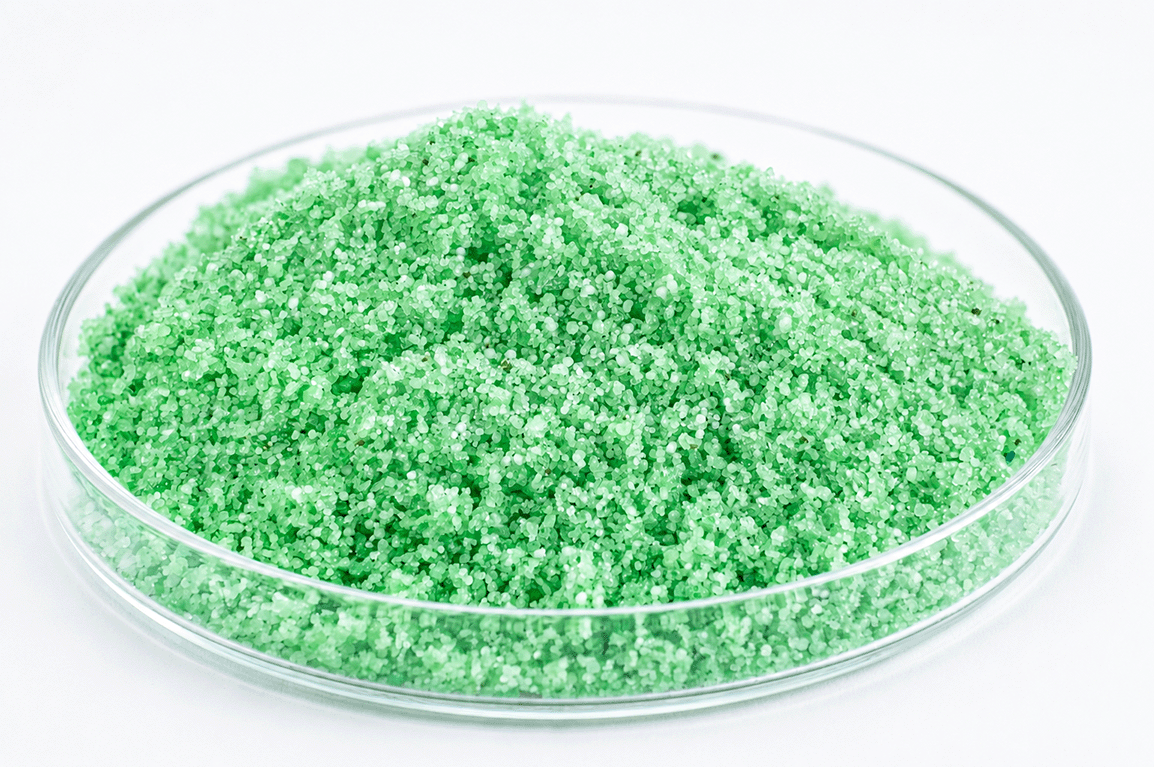
| APPEARANCE: | Water Soluble Powder |
| PACKAGING: | 25 Kg |
SPECIFICATION |
W/W |
|---|---|
| Total Nitrogen (N) | 20% |
| – Nitric Nitrogen (N-NO3) | 6% |
| – Ammoniacal Nitrogen (N-NH4) | 4% |
| – Ureic Nitrogen (N-NH2) | 10% |
| Phosphorus (P2O5) | 20% |
| Potassium (K2O) | 20% |
| Iron (Fe), EDTA-chelated | 1,000 ppm |
| Manganese (Mn), EDTA-chelated | 500 ppm |
| Zinc (Zn), EDTA-chelated | 100 ppm |
| Copper (Cu), EDTA-chelated | 100 ppm |
| Boron (B) | 200 ppm |
| Molybdenum (Mo) | 100 ppm |
Description
NPK 20-20-20+TE supplies nitrogen, phosphate and potassium in equal measure, the profile growers reach for when a crop needs steady, all-round nutrition rather than a stage-specific push. It is fully water-soluble and dissolves to a clear solution, carrying its nitrogen across nitrate, ammoniacal and urea forms for a mix of immediate and sustained availability, alongside an EDTA-chelated package of iron, manganese, zinc, copper, boron and molybdenum. The grade fits routine maintenance feeding and mixed programs where a single balanced formulation is applied through drip lines or foliar sprays. With an even 1:1:1 ratio, nothing in the feed is steered ahead of anything else, which is what makes it a true maintenance grade.
Key Benefits
- Delivers balanced macronutrient nutrition. Equal nitrogen, phosphate and potassium meet routine crop demand without skewing growth toward canopy, root or fruit, so the grade fits the widest range of crops and stages.
- Feeds with a balanced nitrogen profile. Its mix of nitrate, ammonium and urea nitrogen combines immediate uptake, steady root-zone feeding and sustained release, matching the grade’s all-round maintenance role.
- Supports rooting and energy transfer. The phosphate fraction supplies phosphorus for root development and the plant’s energy metabolism through active growth.
- Dissolves fully for clean fertigation and foliar use. It forms a clear solution that runs through drip lines and spray tanks without residue or clogging.
- Supplies trace elements with defined roles. The EDTA-chelated package keeps iron and manganese available for chlorophyll formation and photosynthesis, zinc for growth-hormone synthesis and shoot development, copper for enzyme and defence function, boron for pollination, fruit set and cell-wall strength, and molybdenum for nitrogen metabolism, all held soluble and root-available across typical solution pH.
How It Works
NPK 20-20-20+TE is a fully water-soluble mineral fertiliser that dissolves to a clear solution and delivers nitrogen, phosphate and potassium as plant-available ions, taken up through the roots in fertigation or through the leaf in foliar application. Because the nutrients are already in mineral, ionic form, the crop uses them without further breakdown, so the ratio in the tank is what shapes the feed the plant receives at each stage.
In this grade the nitrogen is split roughly 30% nitrate, 20% ammonium and 50% urea, deliberately spread across all three forms so it behaves well almost anywhere. Nitrate is taken up at once and, as an anion, is drawn in alongside cations such as potassium, calcium and magnesium, so it feeds immediately while helping keep the root zone from turning acidic. The ammonium share is kept modest on purpose: a little ammonium gently acidifies the rhizosphere and improves the uptake of phosphorus and trace elements, but too much risks toxicity, so it sits at a level that aids uptake without that risk. The urea, the largest fraction, is what lets the grade carry a full 20% nitrogen and also makes it foliar-friendly, since urea is a small neutral molecule that crosses the leaf surface easily and then converts through ammonium to nitrate to extend the feed. The EDTA-chelated micronutrients stay soluble and root-available across the mildly acidic to neutral pH this balanced mix maintains.
When to Use NPK 20-20-20+TE
Use it as the backbone feed through the main growing period, wherever a balanced supply suits the crop and stage.
- NPK 20-20-20+TE suits routine maintenance feeding from establishment through active growth on most crops.
- It works as an all-round base feed in mixed cropping programs where a single balanced grade is preferred over stage-specific formulations.
- It supports transplants and young plants that need moderate, even nutrition before switching to a stage-specific ratio.
As a balanced grade it is the feed to hold to when crop demand is general rather than concentrated on canopy, roots or fruit; move to a higher-nitrogen, higher-phosphate or higher-potassium grade when a specific stage takes over.
Because half its nitrogen is urea and a fifth ammonium, it has a mild acidifying effect on the root zone as that nitrogen converts; factor this into pH management on already-acidic substrates.
Application
Rates scale with crop, stage and system. As a starting point, dissolve at 1 to 2 g/L for constant-feed fertigation, dropping to 0.5 to 1 g/L for seedlings and young plants and rising to around 3 g/L or a little above for established heavy feeders at peak demand. Keep the nutrient-solution EC within the crop’s tolerance, and for foliar use stay near 1 to 2 g/L and spray in early morning or late afternoon, never in midday heat.
The table below covers the crops and stages this grade suits, with starting rates to fine-tune to local water quality and the crop’s salinity tolerance. Fertigation figures are concentrations for constant feeding in the irrigation water; foliar figures are spray concentrations.
| Crop | Stage / timing | Fertigation (g/L) | Foliar (g/L) |
|---|---|---|---|
| Seedlings & young plants | Early growth / establishment | 0.5–1 | 1–2 |
| Leafy vegetables | Whole-cycle maintenance | 1–2 | 2–3 |
| Fruiting vegetables | Vegetative to early fruiting | 1.5–2.5 | 2–3 |
| Strawberry & berries | Vegetative to early production | 1–2 | 1.5–2.5 |
| Top fruit & vine | Post-flowering, fruit development | 1.5–3 | 2–4 |
| Ornamentals & nursery | General feeding | 1–2 | 1.5–2.5 |
Use the lower end on young or sensitive crops and the upper end on established, tolerant crops. For
foliar use, spray in early morning or late afternoon, never in heat, and keep the nutrient-solution
EC within the crop’s tolerance.


Anthony Nguyen


Download product document
Enter your informations to receive the product document by email.t
Monoammonium Phosphate MAP 12-61-0 is a defined mineral salt that dissociates cleanly into ammonium and dihydrogen phosphate ions, delivering a very high 61% P2O5 alongside 12% ammoniacal nitrogen in a fully water-soluble, chloride-free form. The ammonium fraction lowers pH in the immediate root zone as it nitrifies, which improves the availability of phosphorus and other […]
Monopotassium Phosphate MKP 0-52-34 is a defined mineral salt that dissociates into dihydrogen phosphate and potassium ions, delivering a high 52% P2O5 and 34% K2O with no nitrogen and no chloride. Carrying both nutrients without a nitrogen load, MKP supplies phosphorus and potassium exactly when a crop needs them most, at bloom, fruit set, and […]
NPK 30-10-10+TE concentrates its analysis on nitrogen, most of it in urea form, to fuel the rapid leaf and shoot growth of the vegetative phase. Alongside the 30% nitrogen it carries a background of phosphate and potassium, 2% magnesium (MgO) for chlorophyll, and an EDTA-chelated micronutrient package. Fully water-soluble, it dissolves to a clear solution […]
TERRA FUL is the base fulvic acid conditioner in the TERRA range, with no added rooting hormone. It carries 52% organic matter with 38% as fulvic acid and 4.5% water-soluble potassium (K2O), together with organic nitrogen in amino-acid form. Its fulvic acid and organic acids are naturally present in vinasse, a byproduct long documented as […]