







NPK 30-10-10+TE
| FUNCTIONS: | Vegetative growth – Canopy development – High-nitrogen feeding – Chlorophyll support – Micronutrient supply |
| FOR: | Leafy vegetables, cereals and grasses, young tree and vine canopies, and any crop in a rapid vegetative phase |
| APPEARANCE: | Water Soluble Powder |
| PACKAGING: | 25 Kg |
SPECIFICATION |
W/W |
|---|---|
| Total Nitrogen (N) | 30% |
| – Nitric Nitrogen (N-NO3) | 3% |
| – Ammoniacal Nitrogen (N-NH4) | 2% |
| – Ureic Nitrogen (N-NH2) | 25% |
| Phosphorus (P2O5) | 20% |
| Potassium (K2O) | 20% |
| Iron (Fe), EDTA-chelated | 1,000 ppm |
| Manganese (Mn), EDTA-chelated | 500 ppm |
| Zinc (Zn), EDTA-chelated | 100 ppm |
| Copper (Cu), EDTA-chelated | 100 ppm |
| Boron (B) | 200 ppm |
| Molybdenum (Mo) | 100 ppm |
Description
NPK 30-10-10+TE concentrates its analysis on nitrogen, most of it in urea form, to fuel the rapid leaf and shoot growth of the vegetative phase. Alongside the 30% nitrogen it carries a background of phosphate and potassium, 2% magnesium (MgO) for chlorophyll, and an EDTA-chelated micronutrient package. Fully water-soluble, it dissolves to a clear solution for foliar sprays and fertigation when the priority is building canopy and green growth. Its 3:1:1 skew concentrates the feed on nitrogen, so canopy and green growth lead while phosphate and potassium sit in support.
Key Benefits
- Drives vegetative growth. The high nitrogen loading supports rapid leaf area and shoot development through the canopy-building phase.
- Concentrates nitrogen in urea form. The urea-dominant profile is what allows the high nitrogen analysis; urea releases as it converts to extend the feed through the vegetative stage, backed by smaller fast-acting nitrate and steady ammonium fractions.
- Supports chlorophyll and photosynthesis. The added 2% magnesium supplies magnesium at the centre of the chlorophyll molecule, backing the green growth the nitrogen drives.
- Dissolves fully for foliar and fertigation feeding. It forms a clear solution that runs cleanly through spray tanks and drip lines without residue.
- Supplies trace elements with defined roles. The EDTA-chelated package keeps iron and manganese available for chlorophyll formation and photosynthesis, zinc for growth-hormone synthesis and shoot development, copper for enzyme and defence function, boron for pollination, fruit set and cell-wall strength, and molybdenum for nitrogen metabolism, all held soluble and root-available across typical solution pH.
How It Works
NPK 30-10-10+TE is a fully water-soluble mineral fertiliser that dissolves to a clear solution and delivers nitrogen, phosphate and potassium as plant-available ions, taken up through the roots in fertigation or through the leaf in foliar application. Because the nutrients are already in mineral, ionic form, the crop uses them without further breakdown, so the ratio in the tank is what shapes the feed the plant receives at each stage.
Around 83% of the nitrogen here is urea, with only about 10% nitrate and 7% ammonium, and that heavy urea share follows directly from the high nitrogen loading: urea is the most concentrated nitrogen source, so it is the only practical way to pack 30% nitrogen into a fully soluble grade, and it also suits foliar canopy feeding because urea crosses the leaf surface readily. Urea must convert, through ammonium to nitrate, before roots take it up, so it releases gradually and sustains the vegetative push rather than flushing through at once. The small nitrate fraction gives an immediate start, and the small ammonium fraction gently acidifies the root zone to help phosphorus and micronutrient uptake. Because urea and ammonium both rely on warm conditions to convert, the grade performs best once soils and substrates have warmed. The EDTA-chelated micronutrients stay soluble and root-available across typical solution pH.
When to Use NPK 30-10-10+TE
Use it when the crop is in active vegetative growth and building canopy is the priority.
- NPK 30-10-10+TE suits early to mid vegetative growth when leaf and shoot development set the yield potential.
- It supports canopy regrowth after cutting, grazing or pruning on grasses and perennial crops.
- It fits nitrogen-hungry leafy crops through their active growth period.
Hold to this grade while vegetative growth and canopy are the focus; move to a higher-phosphate grade for establishment and rooting, or a higher-potassium grade as fruiting begins.
As its urea-dominant nitrogen converts and nitrifies it has a mild acidifying effect on the root zone, worth noting where substrate pH is already low.
Application
Rates scale with crop, stage and system. As a starting point, dissolve at 1 to 3 g/L, dropping to 0.5 to 1 g/L for young plants and rising toward the top of the range for a vegetative push on established, tolerant crops. Because the nitrogen is largely urea, keep foliar sprays to 1 to 2 g/L and apply only in early morning or late afternoon, never in heat, since high urea raises leaf-scorch risk.
The table below covers the crops and stages this grade suits, with starting rates to fine-tune to local water quality and the crop’s salinity tolerance. Fertigation figures are concentrations for constant feeding in the irrigation water; foliar figures are spray concentrations.
| Crop | Stage / timing | Fertigation (g/L) | Foliar (g/L) |
|---|---|---|---|
| Leafy vegetables | Active vegetative growth | 1–2 | 2–3 |
| Cereals & grasses | Tillering / canopy build | 2–3 | 3–5 |
| Fruiting vegetables | Early vegetative (pre-flower) | 1.5–2.5 | 2–3 |
| Young trees & vines | Spring canopy flush | 1.5–3 | 2–4 |
| Turf & forage | Regrowth after cutting / grazing | 2–3 | 3–5 |
Use the lower end on young or sensitive crops and the upper end for a vegetative push on established,
tolerant crops. Because the nitrogen is largely urea, keep foliar sprays to the lower end and apply
only in early morning or late afternoon, never in heat, to avoid leaf scorch, and keep the
nutrient-solution EC within the crop’s tolerance.


saleen

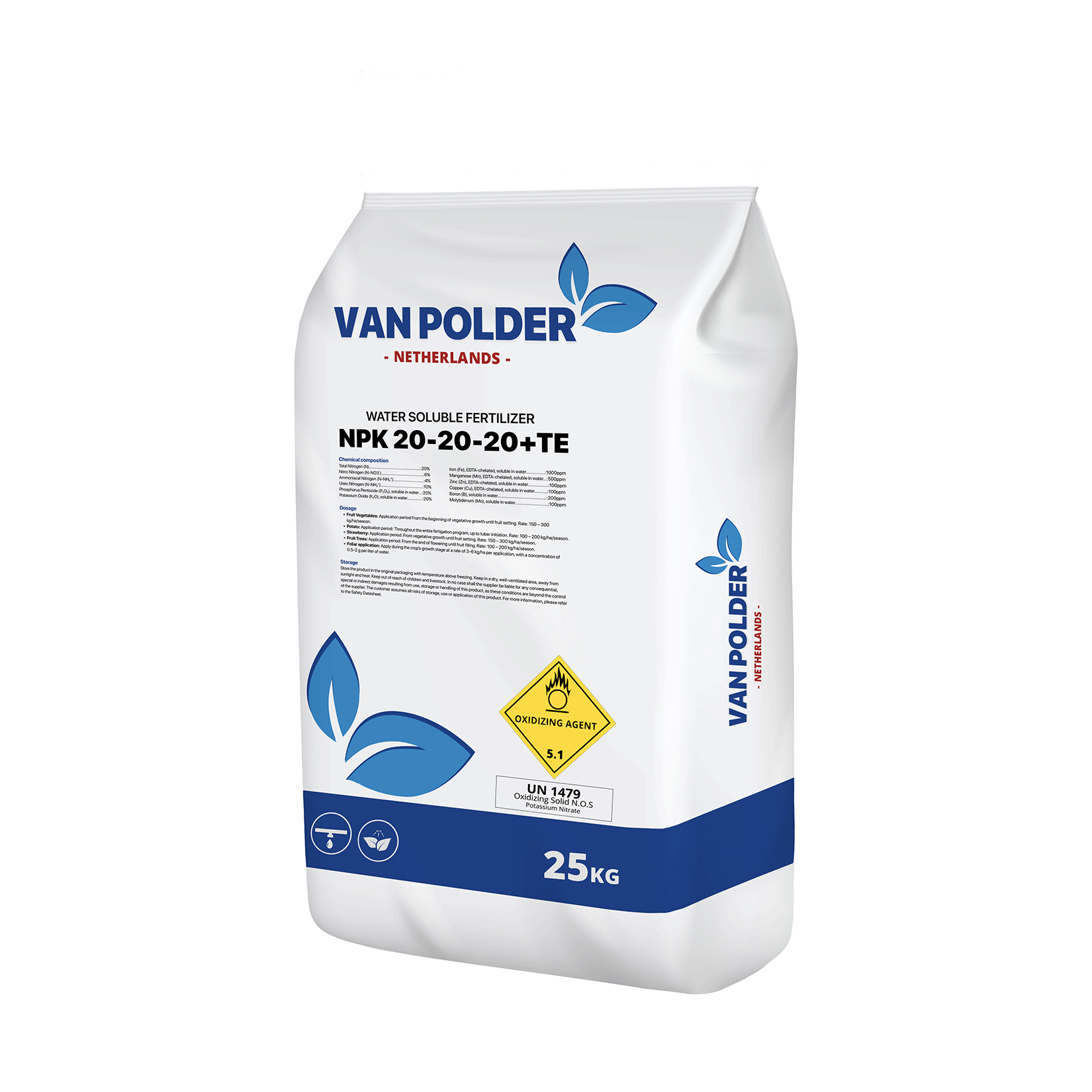
NPK 20-20-20+TE supplies nitrogen, phosphate and potassium in equal measure, the profile growers reach for when a crop needs steady, all-round nutrition rather than a stage-specific push. It is fully water-soluble and dissolves to a clear solution, carrying its nitrogen across nitrate, ammoniacal and urea forms for a mix of immediate and sustained availability, alongside […]
NPK 19-19-19+TE carries its nitrogen entirely as nitrate and ammonium, with no urea, so the feed behaves predictably in the tank and in the root zone. It supplies nitrogen, phosphate and potassium in equal balance and is fully water-soluble, dissolving to a clear solution with an EDTA-chelated package of iron, manganese, zinc, copper, boron and […]
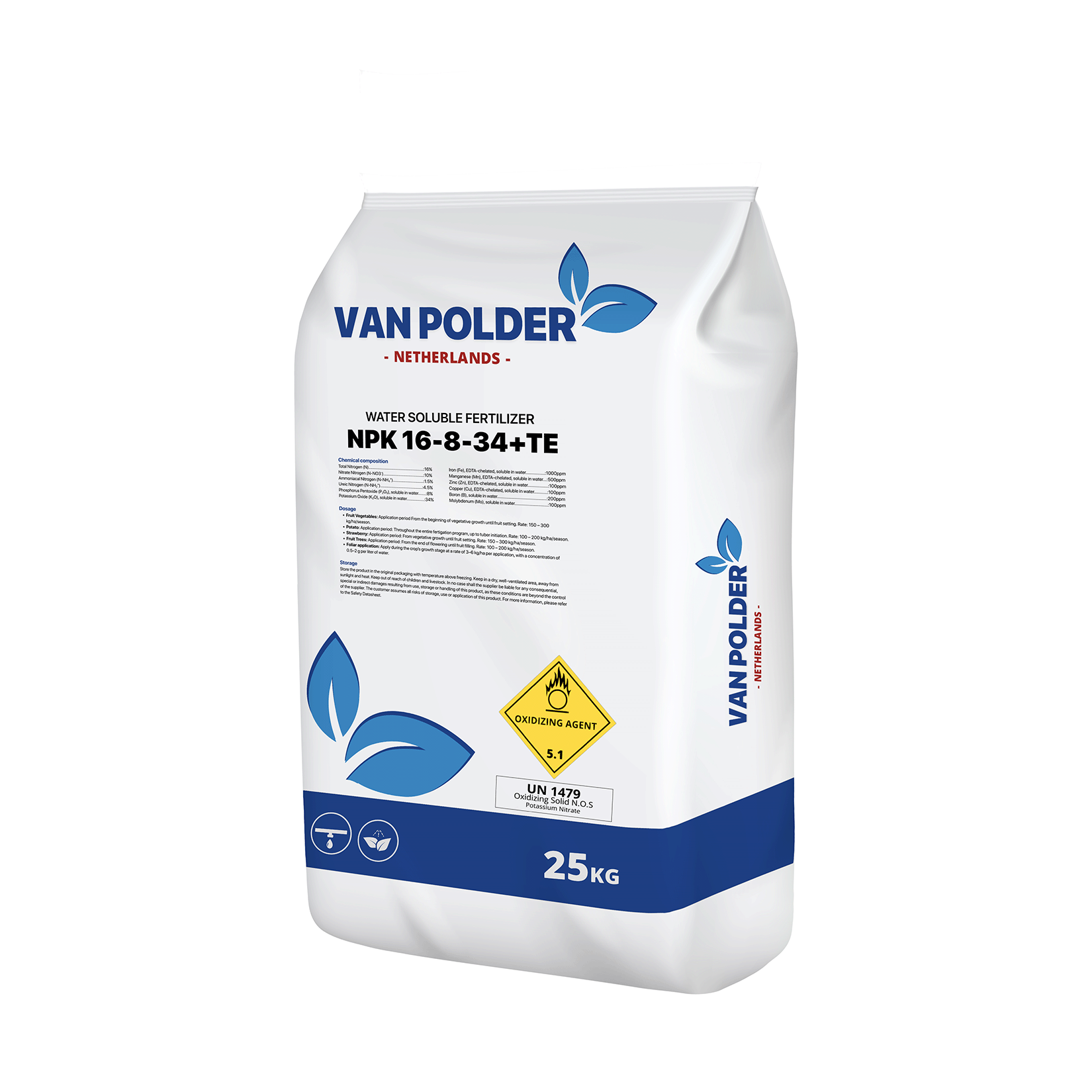
NPK 16-8-34+TE lifts potassium for fruit development while holding more phosphate than a pure ripening grade, bridging the stage where a crop is still setting fruit but potassium demand is climbing. Its potassium is drawn from potassium nitrate, delivering high, chloride-free potassium with nitrate-led nitrogen, alongside a retained phosphate fraction and an EDTA-chelated micronutrient package. […]
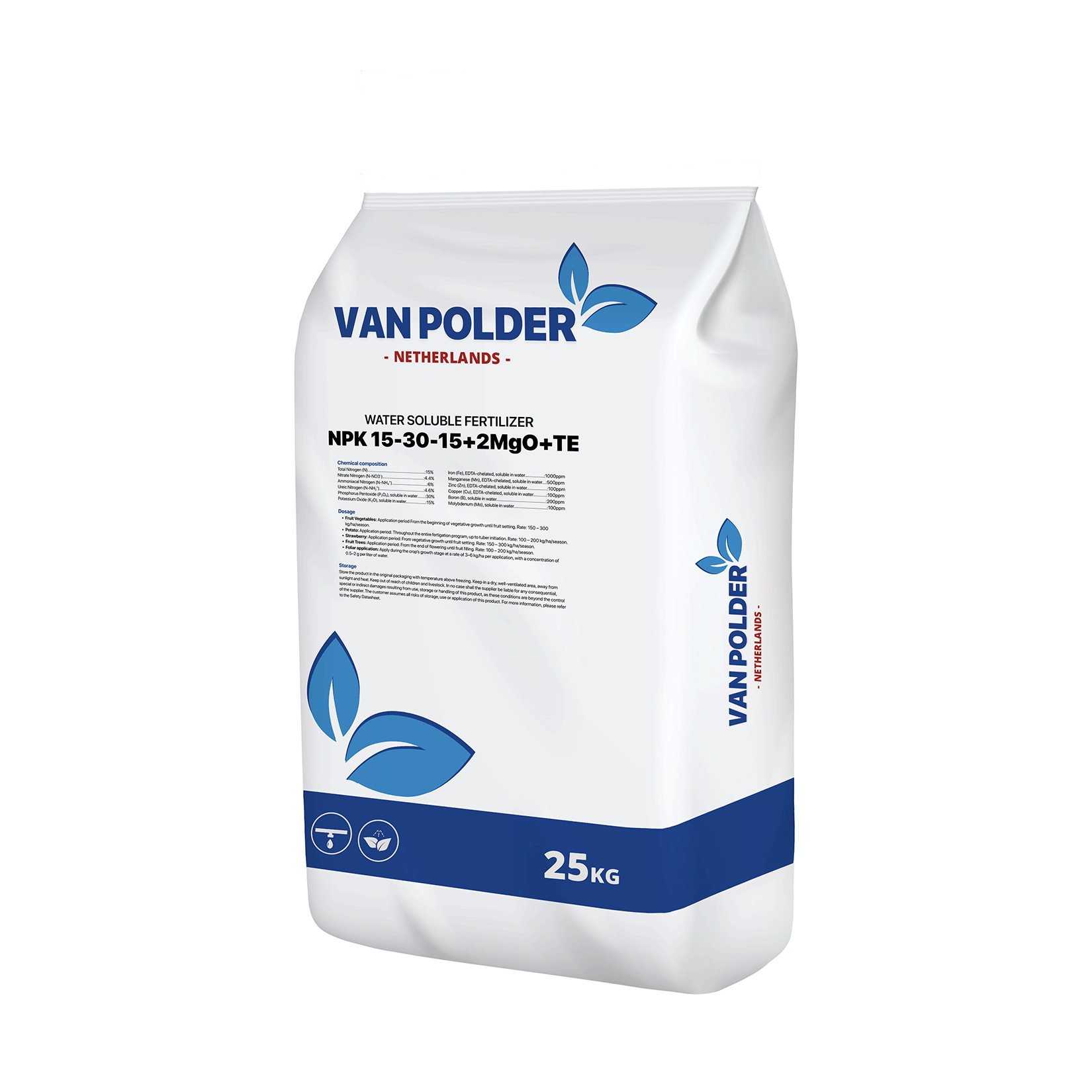
NPK 15-30-15+2MgO+TE lifts phosphate for flowering and fruit set while keeping nitrogen and potassium balanced and adding magnesium for chlorophyll. The 30% phosphate supplies the phosphorus that bud development and bloom demand, backed by nitrogen across nitrate, ammoniacal and urea forms, 2% magnesium (MgO), and an EDTA-chelated micronutrient package that includes boron. Fully water-soluble, it […]
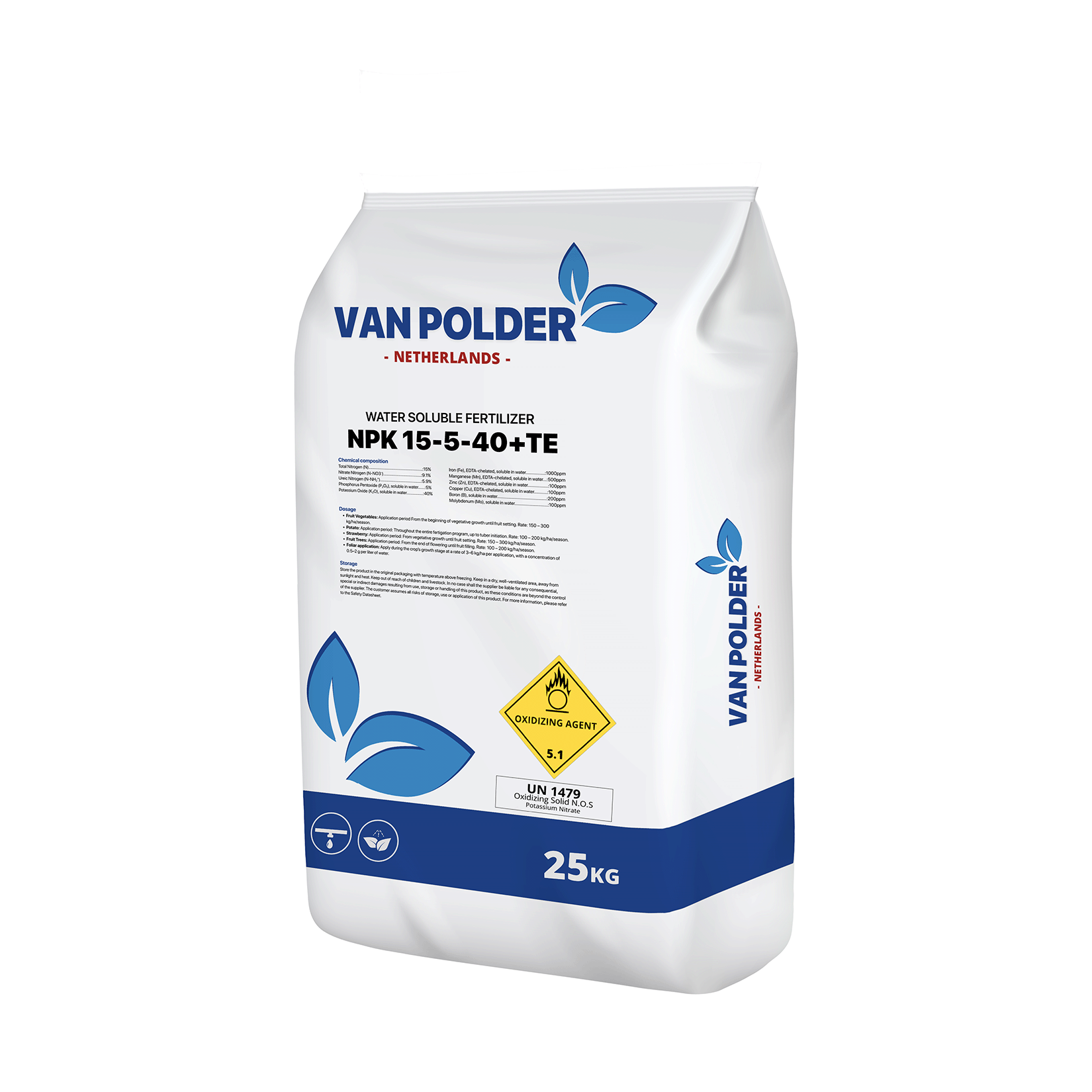
NPK 15-5-40+TE loads potassium well above nitrogen and phosphate, the profile for the fruit-fill and ripening window when potassium demand peaks. The potassium is drawn from potassium nitrate, so it carries high potassium and mobile nitrate nitrogen with no chloride load, alongside a low phosphate fraction and an EDTA-chelated micronutrient package. Fully water-soluble, it dissolves […]