







Potassium Deficiency in Banana: Symptoms and Correction
Potassium deficiency in banana shows first on the oldest leaves, as an orange-yellow chlorosis that is followed by rapid leaf death, and it ends in smaller bunches with thin fruit. Below: how to recognize it, why it appears even on high-K soils, how to confirm it with leaf analysis and how to correct it without […]


Potassium deficiency in banana shows first on the oldest leaves, as an orange-yellow chlorosis that is followed by rapid leaf death, and it ends in smaller bunches with thin fruit. Below: how to recognize it, why it appears even on high-K soils, how to confirm it with leaf analysis and how to correct it without causing a magnesium problem. For the full nutrition program, see the Fertilizer for banana plants: nutrient needs, rates and growth-stage guide.
Why potassium matters so much in banana
Potassium (K) is the most important element in banana nutrition, and a fully grown bearing plant contains more K than all other minerals combined (Robinson & Galán Saúco, 2010). It controls the opening and closing of stomata, which regulates water uptake, and it moves sugars from the leaves to the fruit (Weinert & Simpson, 2016).
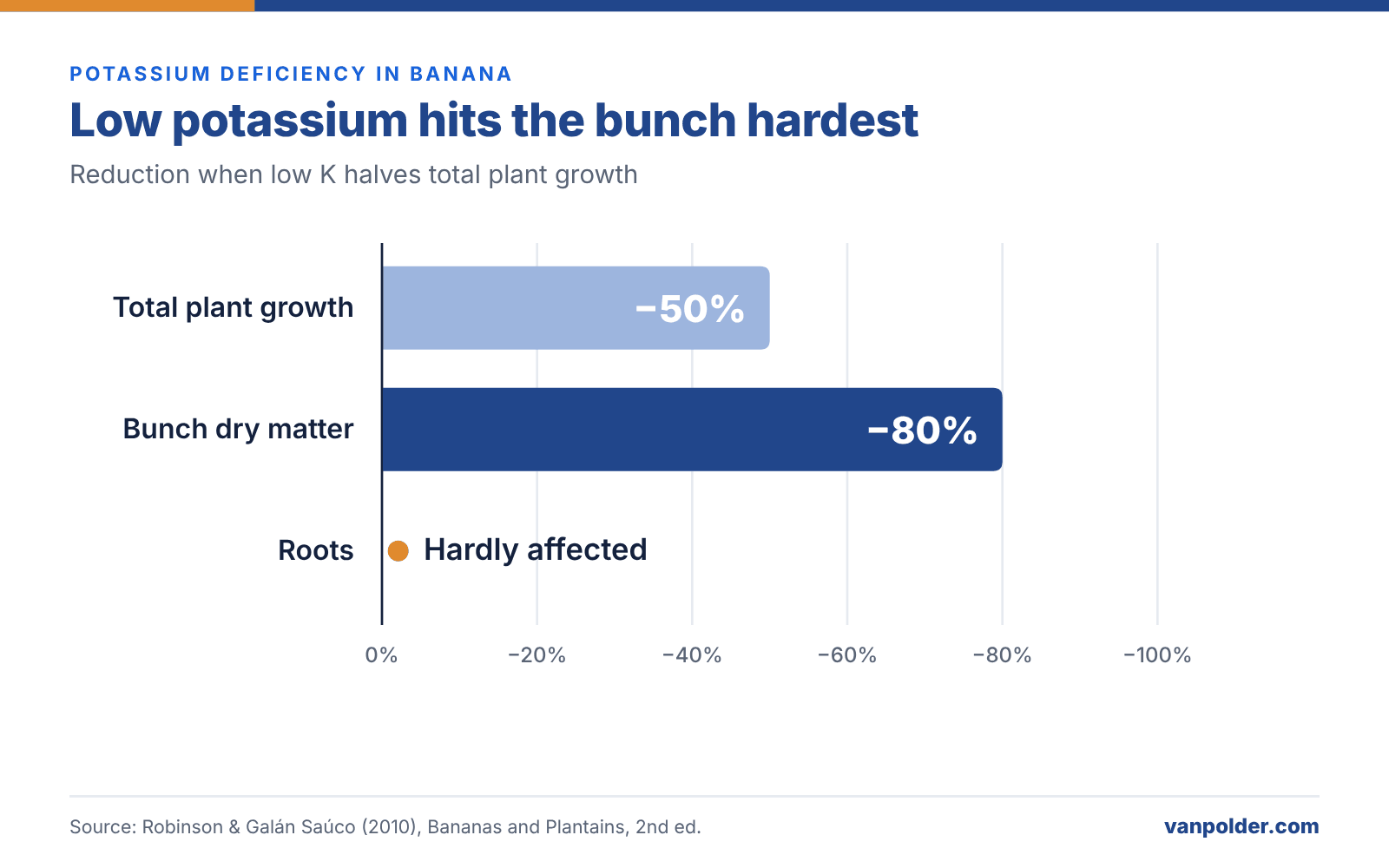
The bunch suffers most when K runs short. When low K halves total plant growth, bunch dry matter can fall by 80% while the roots are hardly affected, because photosynthesis, sugar transport to the bunch and starch formation in the fruit all slow down (Robinson & Galán Saúco, 2010).
Most K is taken up during vegetative growth; once the bunch develops, it draws on K stored in other organs (Robinson & Galán Saúco, 2010). If supply falls short, a plant can bunch normally and then lose its leaves as K is withdrawn to fill the fruit (Sathiamoorthy & Jeyabaskaran, n.d.). See Bunch filling: nutrition from shooting to harvest.
Potassium deficiency symptoms in banana leaves and bunches
K is mobile in the plant, so the oldest leaves show the deficiency first. Look for:
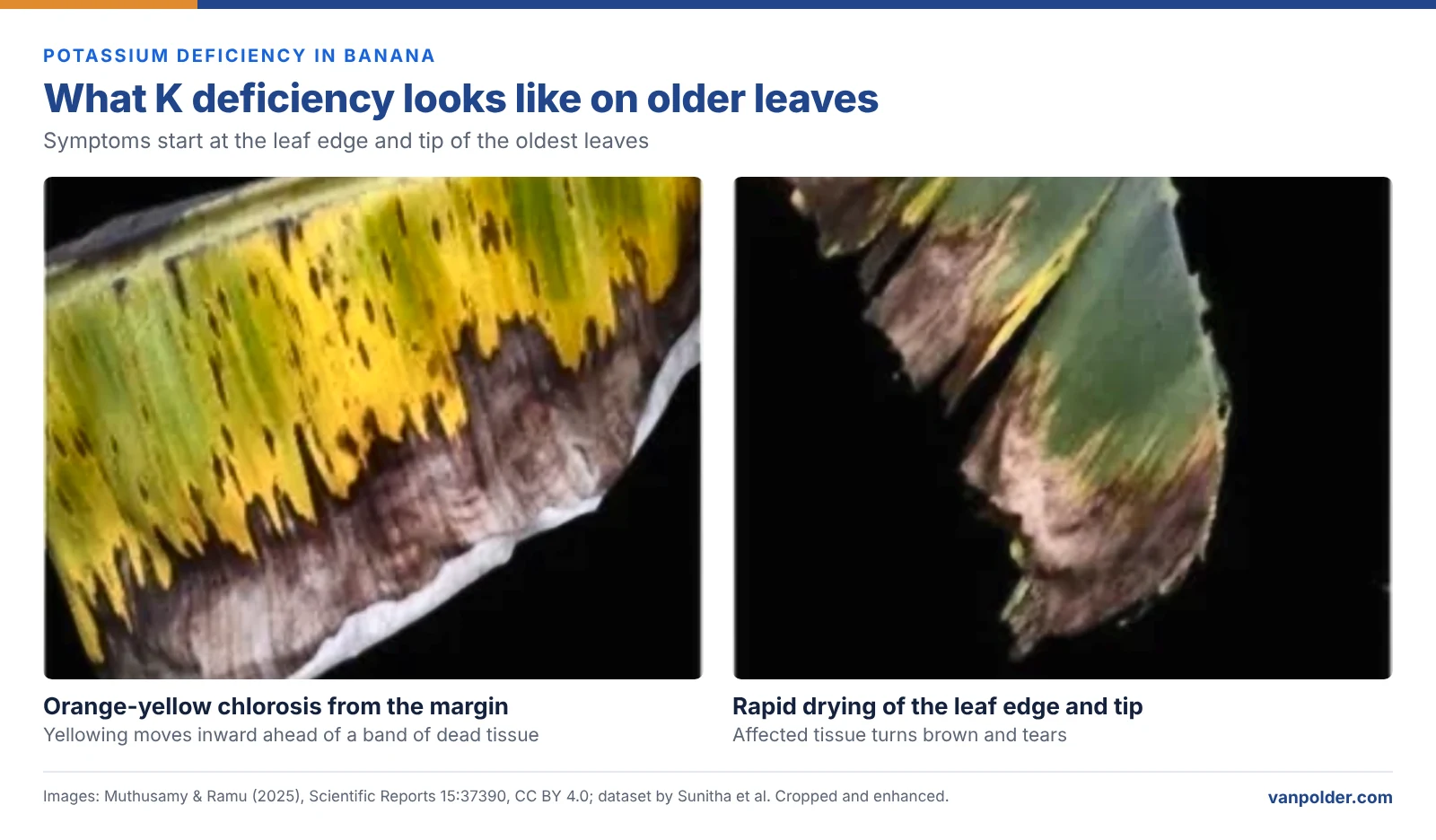
- orange-yellow chlorosis on the oldest leaves, starting at the leaf tips, followed by rapid drying and death of those leaves (Robinson & Galán Saúco, 2010; Weinert & Simpson, 2016)
- a midrib that curves so the leaf tip points back toward the base of the plant; in plantations protected from wind, mild deficiency shows as downward curling and orange-yellow coloring at the leaf tip (Sathiamoorthy & Jeyabaskaran, n.d.; Weinert & Simpson, 2016)
- reduced leaf size and shorter leaf life, so the plant carries less leaf area (Sathiamoorthy & Jeyabaskaran, n.d.)
- delayed bunch initiation, fewer fruits per bunch and thin, poorly filled fingers (Robinson & Galán Saúco, 2010), and choking (Sathiamoorthy & Jeyabaskaran, n.d.)
Several deficiencies cause yellow leaves. This table separates potassium deficiency symptoms in banana from the common look-alikes (full visual guide: Banana nutrient deficiency symptoms: visual guide).
| Nutrient | Which leaves | Typical pattern |
| Potassium | Oldest | Orange-yellow chlorosis from the tip, rapid leaf death, tip curling toward the plant base |
| Nitrogen | Oldest first, then younger | General pale yellowing and poor growth; in young plants, pink or red coloring on the petiole wings |
| Magnesium | Older | Yellowing in the middle of the leaf blade while the margins and the area near the petiole stay green; bluish-purple petioles |
| Calcium | Youngest | Interveinal chlorosis near the leaf edge, serrated leaf margins, deformed new leaves (“spike leaf”) |
Sources: Weinert & Simpson (2016); Robinson & Galán Saúco (2010).
Nitrogen and potassium deficiency are easily confused (Weinert & Simpson, 2016); a leaf analysis settles it.
What causes potassium deficiency in banana
Potassium deficiency in banana plants does not always mean the soil is short of K. Common causes:
- Leaching on light soils. K leaches easily, and 20 to 30% of potassium can be lost through leaching, so sandy soils need smaller, more frequent applications (Weinert & Simpson, 2016).
- Cation imbalance. Calcium, magnesium and sodium compete with K for uptake. A soil K level of 200 to 350 mg/kg is usually sufficient, but a K deficiency can still develop where Mg or Ca reserves are high relative to K (Robinson & Galán Saúco, 2010).
- Salinity. Excess sodium in saline soils or irrigation water depresses K uptake (Sathiamoorthy & Jeyabaskaran, n.d.).
Mindanao soils: when magnesium crowds out potassium
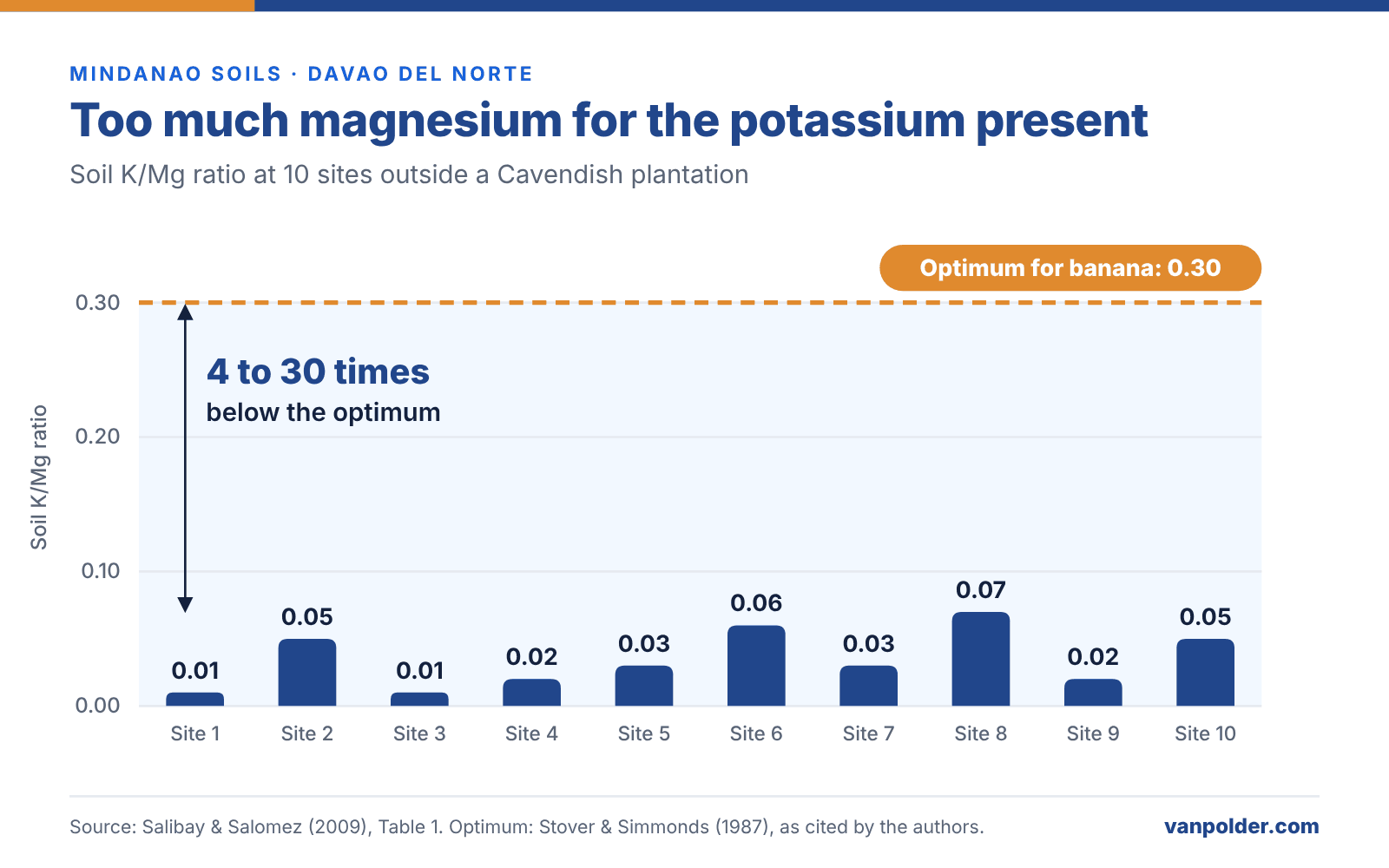
A five-year study of a Cavendish plantation in Davao del Norte found soils naturally high in K, Ca and Mg, with magnesium dominating the exchange complex (Salibay & Salomez, 2009). Soil K/Mg ratios outside the plantation were 0.01 to 0.07, far below the 0.30 the authors cite as optimal for banana. Inside it, exchangeable K was very high (1.99 to 3.90 cmol(+)/kg) but was not reflected in leaf K, and leaf Mg was linked to lower bunch weight in most years. A higher K/Mg ratio went with heavier bunches, yet in some years the recommended K rate correlated negatively with bunch weight.
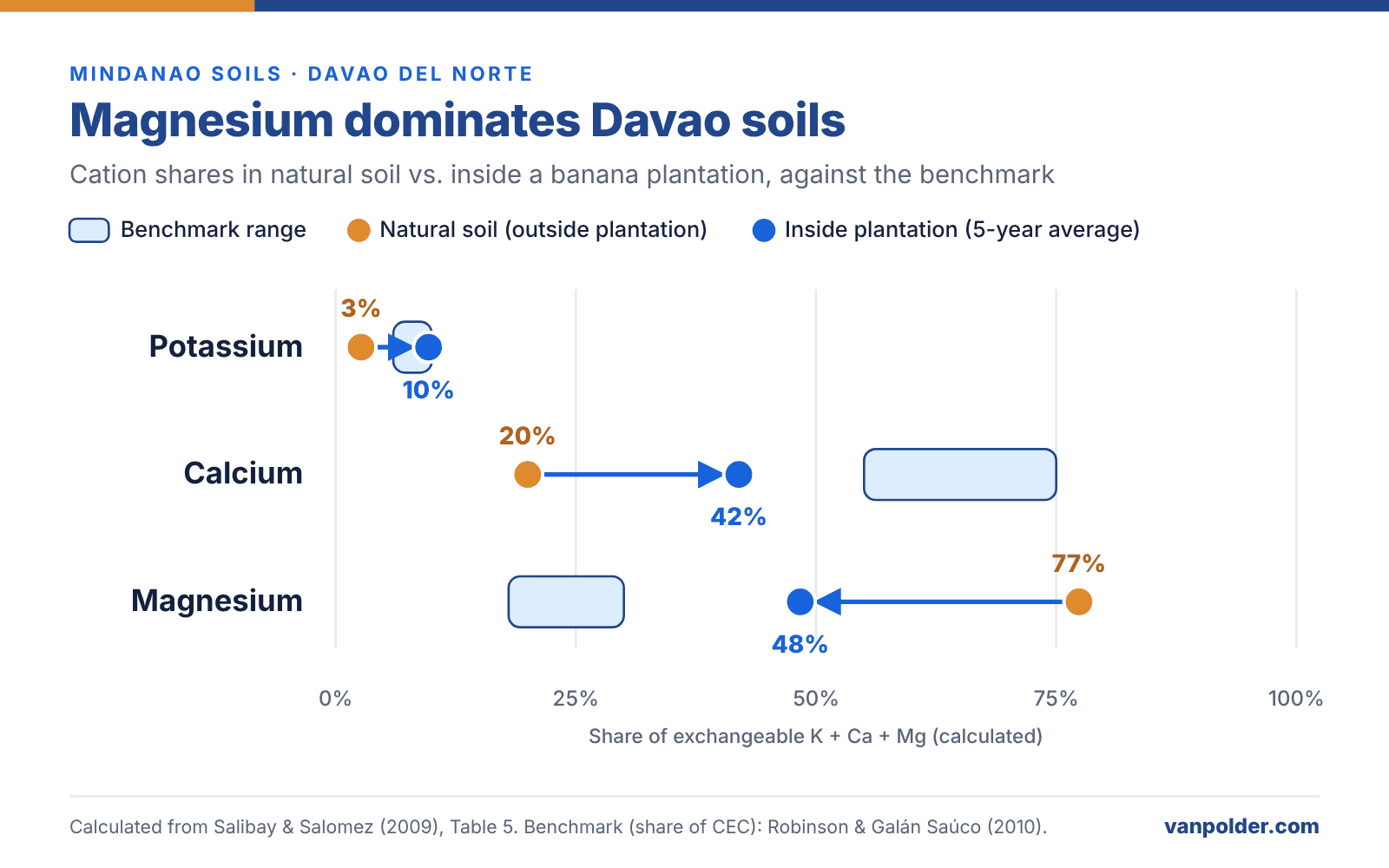
Calculated from the study’s soil data, magnesium made up about 77% of exchangeable K, Ca and Mg in the natural soil and 48% inside the plantation, against a benchmark of 18–30% (Salibay & Salomez, 2009; Robinson & Galán Saúco, 2010).
For Mindanao growers, fertilize to the K:Mg:Ca balance your soil and leaf tests show, not to a fixed K rate (see Magnesium for banana and the Ca:Mg:K balance in Davao soils).
How to confirm a deficiency: leaf and soil analysis
The Philippine Code of Good Agricultural Practice for banana calls for fertilizers to be applied based on soil and/or leaf analysis (PNS/BAFS 129:2013).
How to sample leaves:
- Sample plants that have just produced an inflorescence but not yet a developed bunch, at the same stage each time (Robinson & Galán Saúco, 2010; Weinert & Simpson, 2016).
- Take the third youngest fully open leaf. At the midpoint of the leaf, cut lamina samples from both sides of the midrib (Robinson & Galán Saúco, 2010; Weinert & Simpson, 2016).
- Sample at least 10, preferably 20, plants per uniform block, and keep blocks and cultivars separate (Robinson & Galán Saúco, 2010; Weinert & Simpson, 2016).
- Don’t sample leaves shortly after a foliar fertilizer spray, because residue on the leaf distorts the result (Weinert & Simpson, 2016).
- Take soil samples at least six weeks after fertilizing (Weinert & Simpson, 2016).
How to read the result:
| Reference | Leaf K (third leaf, % of dry matter) | Conditions |
| Critical concentration (Lahav & Turner, 1983, cited in Robinson & Galán Saúco, 2010) | 3.0 | AAA Cavendish, several regions |
| Normal range, ARC-ITSC South Africa (in Robinson & Galán Saúco, 2010) | 3.0–4.0 | Cavendish |
| Optimum, Cavendish (Weinert & Simpson, 2016) | 3.0–4.0 | Subtropical Australia |
| Optimum, Ladyfinger (Weinert & Simpson, 2016) | 2.4–3.2 | AAB cultivar |
| Range linked to 90–100% of maximum yield (Villaseñor-Ortiz et al., 2022) | 3.4–3.5 | ‘Williams’ Cavendish, Ecuador |
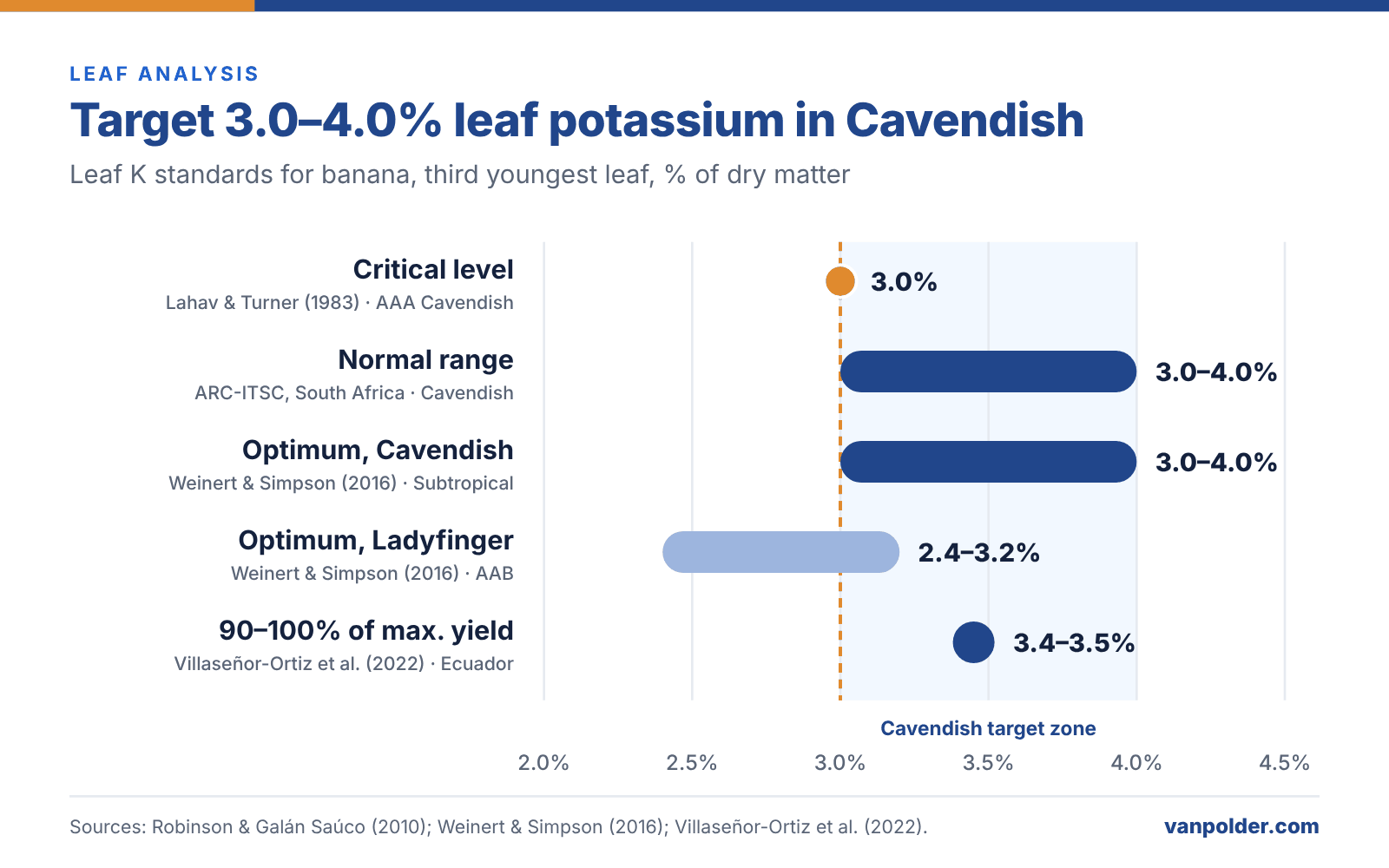
Cultivars with more Musa balbisiana in their genome have lower leaf standards than Cavendish (Weinert & Simpson, 2016), so judge cooking bananas against cultivar-specific norms. Always read K together with Ca and Mg. A useful soil benchmark is the cation share of the exchange capacity: about 55–75% Ca, 18–30% Mg and 6–10% K (Robinson & Galán Saúco, 2010).
How to correct potassium deficiency in banana
1. Fix the rate with soil-applied K
Set the soil or fertigation rate from leaf results and records, not symptoms alone. Weinert & Simpson (2016) give a worked example: if Cavendish leaf K is 2.4% after 200 kg/ha of K in the past year, increase the rate by about 20% to 240 kg/ha, then re-sample at the same time the following year and adjust again. A yield response is most likely where K is limiting: in Uganda, where leaf diagnosis showed K and Mg as the most limiting nutrients, 100 kg/ha of K per year gave higher yields than no K (Smithson et al., 2004).
2. Split applications on light soils
Apply K more often on sandy and light soils (Weinert & Simpson, 2016). Soils with a medium K-fixing capacity may need more than the common three applications per crop (Sathiamoorthy & Jeyabaskaran, n.d.); fertigation makes frequent small doses practical.
3. Watch magnesium as K goes up
Raising K can push magnesium into deficiency. In banana, higher K supply reduced the uptake of Mg, Ca, N and Cu (Turner & Barkus, 1983), and across crops K suppresses Mg uptake more strongly than the reverse (Xie et al., 2021). In a field trial on ‘Prata Anã’ banana, higher K doses raised leaf K and Ca but lowered leaf Mg and B (da Silva et al., 2013). Re-check leaf Mg after any large increase in K.
Where soils are already high in Mg, as in parts of Davao, extra Mg is unlikely to help: increasing Mg doses reduced bunch weight in the first cycle of the ‘Prata Anã’ trial (da Silva et al., 2013), and in Uganda yields with K plus Mg tended to be lower than with K alone, though not significantly (Smithson et al., 2004).
4. Use foliar K as a supplement, not a replacement
Foliar K can top up supply during periods of high demand such as bunch filling. In a two-season trial on ‘Williams’ banana in Egypt, soil K at 40–80% of the recommended rate combined with foliar K sprays gave better yield and fruit quality than the same soil K alone (Hussein & Gad El-Kareem, 2021). Treat it as an addition to a soil or fertigation program set by leaf analysis, not a substitute.
Choosing a potassium source
K sources differ in their accompanying nutrient (chloride, sulfate or nitrate) and in fertigation suitability. They are compared in Potassium nitrate vs SOP vs MOP for bananas, with an overview in Potassium fertilizers: roles, sources and deficiency.
Van Polder products for correcting potassium deficiency
- Potassium nitrate PURE (NPK 13.6-0-46.2): a water-soluble source of K with nitrate nitrogen, suited to fertigation and foliar programs. In the Philippines, potassium nitrate is a regulated product, so check availability with your distributor.
- Sulfate of potash (SOP) (NPK 0-0-51+18S): a water-soluble, chloride-free K source that also supplies sulfur.
- WSF NPK 15-5-40+TE: a high-K water-soluble NPK with trace elements for fertigation during bunch filling.
- HYD AA POTAS K21: a liquid amino acid biostimulant that also contains 21% K2O (32% total amino acids, 20% organic carbon). Use it alongside your K fertilizer program, not instead of it.
Follow the product label for application rates, and set your K rate from leaf and soil analysis.
Frequently asked questions
What does potassium deficiency look like in banana leaves?
The oldest leaves turn orange-yellow from the tip and then dry out and die quickly. The midrib often curves so the leaf tip points toward the base of the plant, and new leaves come out smaller (Robinson & Galán Saúco, 2010; Sathiamoorthy & Jeyabaskaran, n.d.).
Is potash deficiency the same as potassium deficiency?
Yes. “Potash” is the trade name for potassium fertilizers such as muriate of potash and sulfate of potash, so potash deficiency in banana means the plant is short of potassium.
Can banana show potassium deficiency when the soil test shows high potassium?
Yes. High magnesium or calcium can limit K uptake even when soil K is adequate (Robinson & Galán Saúco, 2010). In a Davao plantation with very high soil K, leaf K did not follow soil K, and the soil’s high Mg was linked to lower bunch weight (Salibay & Salomez, 2009). Compare soil K with soil Mg and Ca, not on its own.
Next step
If you see orange-yellow older leaves, take a leaf sample and a soil sample before you change your K rate, and read K together with Mg and Ca. Then set the rate and source for your soil and irrigation system using the Banana Nutrition Guide for the Philippines, or contact a Van Polder distributor to discuss a program.
Sources
- Robinson, J.C. & Galán Saúco, V. (2010). Bananas and Plantains, 2nd edition. Crop Production Science in Horticulture 19. CABI, Wallingford. ISBN 978-1-84593-658-7.
- Weinert, M. & Simpson, M. (2016). Subtropical banana nutrition: matching nutrition requirements to growth demands. NSW Department of Primary Industries. ISBN 978-1-74256-984-0. horticulture.com.au
- Sathiamoorthy, S. & Jeyabaskaran, K.J. (n.d.). Potassium management of banana. National Research Centre for Banana, Tiruchirappalli. International Potash Institute.
- Salibay, M.A.L. & Salomez, J.A. (2009). Banana fertilization at the FPO plantation: evaluation of soil and leaf analysis results. Southeastern Philippines Journal of Research and Development 18(2). https://ejournals.ph/article.php?id=9061
- Bureau of Agriculture and Fisheries Standards (2013). PNS/BAFS 129:2013 Code of Good Agricultural Practices for Banana Production. Department of Agriculture, Philippines. ppssd.buplant.da.gov.ph
- Villaseñor-Ortiz, D., De Mello Prado, R., Luna-Romero, E., Jaramillo-Aguilar, E. & Agurto-Rodriguez, L. (2022). Critical nitrogen and potassium levels and sufficiency ranges for banana cultivation in Ecuador. Fruits 77(1). https://doi.org/10.17660/th2022/002
- Turner, D.W. & Barkus, B. (1983). Long-term nutrient absorption rates and competition between ions in banana in relation to supply of K, Mg and Mn. Fertilizer Research 4: 127–134. https://doi.org/10.1007/BF01053249
- Xie, K., Cakmak, I., Wang, S., Zhang, F. & Guo, S. (2021). Synergistic and antagonistic interactions between potassium and magnesium in higher plants. The Crop Journal 9: 249–256. https://doi.org/10.1016/j.cj.2020.10.005
- da Silva, I.P. et al. (2013). Vegetative development and yield of the banana cv. ‘Prata Anã’ as a function of magnesium and potassium fertilization. IDESIA (Chile) 31(2): 83–88.
- Smithson, P.C., McIntyre, B.D., Gold, C.S., Ssali, H., Night, G. & Okech, S. (2004). Potassium and magnesium fertilizers on banana in Uganda: yields, weevil damage, foliar nutrient status and DRIS analysis. Nutrient Cycling in Agroecosystems 69: 43–49. https://doi.org/10.1023/B:FRES.0000025294.96933.78
- Hussein, M.A. & Gad El-Kareem, M.R. (2021). Effect of soil potassium fertilization and foliar spray of different potassium sources on growth, yield and fruit quality of William banana plants. Journal of Plant Production, Mansoura University 12(10): 1119–1124. https://doi.org/10.21608/jpp.2021.102326.1071


Maharashtra has declared drought in 265 talukas after a weak monsoon, and grape growers in Nashik fear losing at least 40% of this season’s harvest. For anyone supplying fruit growers in India, the next few months are about keeping crops and vines alive and productive with very little water. At Van Polder, we believe drought […]

Denmark’s new nitrogen regulation starts on 1 January 2027, but vegetable growers and several fruit, berry and nursery crops will stay on today’s nitrogen norms for one more year. For anyone supplying high-value horticulture, this is a short pause, not a change of direction. At Van Polder, we believe nitrogen efficiency will matter more every […]
Retailers in the United States report that growers are trimming micronutrient spending this season, while tissue tests keep finding zinc, boron and manganese shortages. At Van Polder, we believe this is the wrong place to save, and the lesson applies to every market our partners serve. When nitrogen, phosphate and potash bills rise, micronutrient fertilizer […]
Water-soluble fertilizer for banana lets you feed the crop through drip in small doses that follow each growth stage, and in trials this gave more fruit from less fertilizer and water than soil-applied fertilizer. The best water-soluble fertilizer for banana is the one that dissolves cleanly in your water, matches the growth stage and costs […]
To increase banana bunch weight, build a large, healthy leaf canopy and good potassium reserves before the bunch emerges, keep water supply steady, and protect the leaves until harvest. Most of the bunch’s potential is set before shooting: the number of fruits depends on the leaf area the plant has when it initiates its flower […]
The right fertilizer for banana plants is the one that matches what the crop removes, what your soil already holds and the stage the plant is in. Banana takes up far more potassium than any other nutrient, followed by nitrogen and calcium, so K supply and timing decide much of the result. This guide covers […]