







How to Increase Banana Bunch Weight: Nutrition and Field Practices
To increase banana bunch weight, build a large, healthy leaf canopy and good potassium reserves before the bunch emerges, keep water supply steady, and protect the leaves until harvest. Most of the bunch’s potential is set before shooting: the number of fruits depends on the leaf area the plant has when it initiates its flower […]


To increase banana bunch weight, build a large, healthy leaf canopy and good potassium reserves before the bunch emerges, keep water supply steady, and protect the leaves until harvest. Most of the bunch’s potential is set before shooting: the number of fruits depends on the leaf area the plant has when it initiates its flower (Rapetti & Dorel, 2022). After shooting you can still help fruits fill, but you cannot add fruits. This guide covers the levers in order of impact, with what the research shows for each. It is part of our guide to fertilizer for banana plants.
| When | Lever | What the evidence shows |
| Before flowering | Leaf area at flower initiation | Sets the number of fruits, the main driver of bunch weight (Rapetti & Dorel, 2022) |
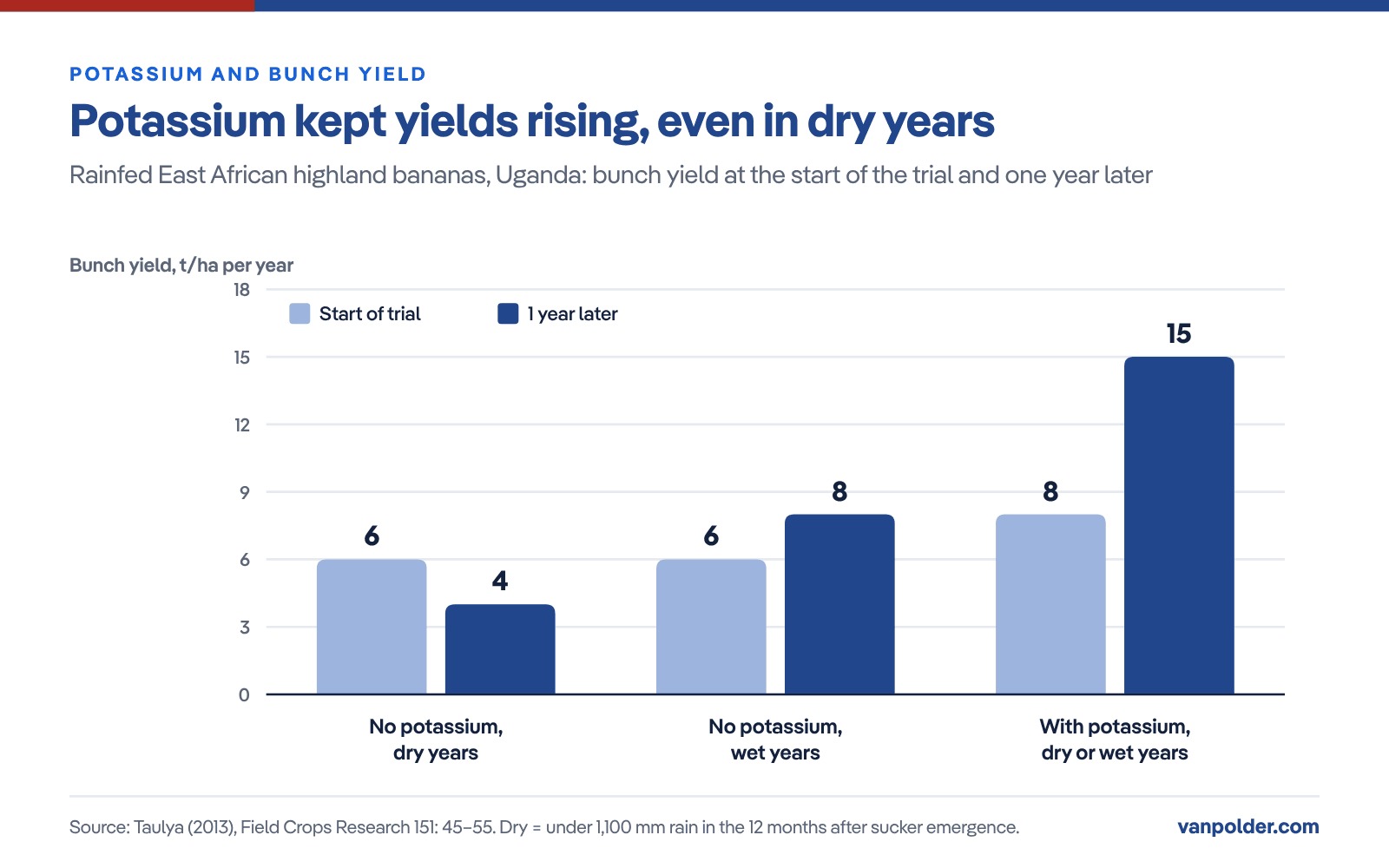
| Before and around shooting | Potassium supply | K input raised bunch yield from 8 to 15 t/ha per year in dry and wet years (Taulya, 2013) |
| Whole cycle | Water | Water stress can cut yield by up to 65%, mainly through lighter bunches (Panigrahi et al., 2021) |
| Flowering to harvest | Keep healthy leaves | Bunch mass is severely reduced with fewer than four healthy leaves at flowering (Robinson & Galán Saúco, 2010) |
| After shooting | Foliar K and Ca | Supplement only; post-shooting SOP sprays added weight in small trials (Ramesh Kumar et al., 2008) |
| At bunch emergence | Bell removal, bunch covers | Remove a competing sink; covers add weight mainly in cool subtropics (Robinson & Galán Saúco, 2010) |
| Planting and follower selection | Plant density | Lower density gave heavier bunches on smallholder farms (Ndabamenye et al., 2012) |
Sources as cited in each row.
What decides how heavy a banana bunch gets
Bunch weight has two parts: how many fruits the bunch carries and how heavy each fruit becomes. In a study of 12 Cavendish cultivars, fruit number depended on the active leaf area at flower initiation, and when the plant was not short of carbohydrate, bunch weight was driven mainly by fruit number rather than fruit weight (Rapetti & Dorel, 2022). Fruit filling then depends on the leaves: they produce the carbohydrates that fill the bunch, and slower leaf production in cool seasons gives slower bunch development and lighter bunches (Weinert & Simpson, 2016).
That gives a simple rule. A vigorous plant with a full canopy at flowering produces a bigger bunch; a plant held back by nutrient shortage, drought or leaf disease before flowering cannot catch up later. A Cavendish plant normally carries 10 to 15 functional leaves when the bunch emerges (Robinson & Galán Saúco, 2010).
Feed potassium before the bunch needs it
Potassium is the nutrient most closely tied to bunch weight. It drives cell division and expansion in the developing fruit, controls stomatal opening and water uptake, and moves sugars from the leaves to the fruit. Plants absorb most of their K in the late vegetative stages, just before bunching, and uptake drops after bunching, so the K that fills the bunch largely has to be in the plant before shooting (Weinert & Simpson, 2016). Shortage shows as yellowing of older leaves and, later, smaller bunches and fruit; see potassium deficiency in banana.
Field trials show how much K can matter where soil supply is short:
- In a field trial in Guangdong, China, adding K to an N and P program raised banana yield by 50.5%; K plus returned banana residues raised it by 71.6% (Zheng et al., 2021).
- In rainfed East African highland bananas in Uganda, K input raised bunch yield from about 8 to 15 t/ha per year within a year, in dry and wet years alike. Without K, yield fell from 6 to 4 t/ha in dry years and only rose from 6 to 8 t/ha in wet years (Taulya, 2013).
- On low-fertility smallholder farms in Rwanda, K was the most limiting nutrient, accounting for a predicted 55% yield gap at the poorest site (Ndabamenye et al., 2013).
Potassium is not the only nutrient that limits bunch weight. Nitrogen builds the leaf area that sets fruit number, magnesium deficiency is the most common after N and K, and zinc is the most important micronutrient for banana (Robinson & Galán Saúco, 2010); leaf analysis shows which one is short. These responses depend on the soil. Where soil K is already high, adding more will not make bunches heavier, and on soils rich in magnesium the balance matters: in a Davao plantation study, a higher soil K/Mg ratio went with heavier bunches (Salibay & Salomez, 2009). Set rates from soil and leaf analysis. For a stage-by-stage program see the banana fertilizer schedule; for choosing between MOP, SOP and potassium nitrate see potash for banana plants; and for potassium sources in general see our guide to potassium fertilizers.
After shooting: foliar potassium and calcium as a top-up
Once the bunch has emerged, soil K uptake slows, so some growers add foliar sprays during bunch filling. In a Robusta trial in India, two sprays of 1.5% sulfate of potash (at last-hand emergence and 30 days later) on top of the full soil program gave bunches of 31.97 kg against 25.27 kg with a water spray, and the treated plants kept more green leaves at harvest (Ramesh Kumar et al., 2008). In Nepal, a foliar mix of 1.5% sulfate of potash and 0.3% calcium nitrate gave 28.40 kg bunches against 24.68 kg in the control, with longer fingers (Sharma et al., 2026).
Treat these as supporting results: both are small trials from single sites, and both added the sprays to a complete soil program. Foliar feeding tops up a well-fed plant; it cannot replace the K the plant should have taken up before shooting.
Calcium matters for fruit quality rather than weight: in calcium-deficient plants fruit quality is inferior and the peel splits easily when ripe (Robinson & Galán Saúco, 2010). See Calcium for banana.
Keep water supply steady
Water stress is one of the biggest causes of light bunches. A review of banana water management found that water stress can reduce yield by up to 65%, mainly through lower bunch weight, even where rainfall is moderate (Panigrahi et al., 2021). Yield losses begin well before drought symptoms become visible; prolonged drought gives choked bunches and short fingers (Robinson & Galán Saúco, 2010).
Water and potassium work together. In the Uganda trial above, plants with K input kept increasing their yield in dry years, while plants without K lost a third of it, which the author linked to K’s role in the plant’s water balance (Taulya, 2013). In dry seasons, irrigation and K supply are both part of protecting bunch weight.
Protect the leaves until harvest
The leaves present at flowering are the only leaves the bunch will get, because no new leaves emerge after shooting. In trials in South Africa and Australia, bunch mass was severely reduced when fewer than four healthy leaves remained at flowering, and green life was affected even with six to eight leaves (Robinson & Galán Saúco, 2010). Control leaf diseases such as Sigatoka, remove only diseased, dead or rubbing leaves, and avoid cutting healthy leaves after flowering.
Bunch management: bell removal, covers and de-handing
| Practice | Effect on bunch weight | Notes |
| Male bud (bell) removal | Removes a competing sink | Break off once the last hands are set; early removal of the bud tip has increased bunch mass in Israel and Mexico but needs expert timing |
| Polyethylene bunch cover | +16.7% bunch mass and +10% finger length in Williams (South Africa) | In tropical trials no yield or finger length difference; the benefit there is blemish and pest control |
| Removing distal hands (de-handing) | Usually lowers total bunch weight | Raises finger length and grade on the remaining hands; useful where export grade matters more than bunch mass |
| Removing healthy leaves at flowering | Lowers bunch weight | Keep as many healthy leaves as possible; remove only diseased, dead or rubbing leaves |
Source: Robinson & Galán Saúco (2010), chapter 11.
De-handing deserves a clear warning: removing the bottom hands makes the remaining fingers longer and raises their grade, but in most trials the total bunch weight fell (Robinson & Galán Saúco, 2010). It is a way to meet export size, not a way to increase bunch weight.
In India, growers also feed nutrients through the cut stalk end of the bunch after removing the male bud (de-navelling). A blend of urea and sulphate of potash (2.5 to 10 g each) in 500 g of fresh cow dung and 100 mL of water is applied to the cut end of the bunch stalk. Across seven cultivars, including Grand Naine, Robusta and Dwarf Cavendish, bunch weight rose by 44.5 to 97.3% compared with untreated bunches, and the benefit:cost ratio improved in every cultivar (Kotur et al., 2014). Labelled-nitrogen measurements in Ney Poovan confirmed that nutrients from the blend moved into the bunch (Kotur & Keshava Murthy, 2010). The method is cheap, but most trials come from one research group in southern India, and part of the gain comes from removing the male bud itself, so try it on a few bunches before using it across a plantation.
Plant density and follower selection
Crowded plants compete for light, water and nutrients. On smallholder farms in Rwanda, the heaviest bunches (18 to 21 kg) came from the lowest plant densities and medium bunches (about 15 kg) from the highest, and lower soil and leaf N, K, Ca and Mg went with smaller bunches (Ndabamenye et al., 2012). In commercial plantations, high density makes the fingers on the lower hands undersized (Robinson & Galán Saúco, 2010). Keep one vigorous follower per mat and a planting density matched to your rainfall and soil.
Bunch weight versus export grade
For export, finger size matters as much as total weight. The Codex standard for Cavendish and Gros Michel bananas sets a minimum finger length of 14 cm and a minimum grade (thickness) of 2.7 cm (Codex Alimentarius, 1997). Good nutrition, water and leaf care raise both weight and finger size; de-handing trades some weight for size.
How to increase banana bunch weight in the Philippines
On acid soil in Misamis Oriental, Saba bunch weight rose from 20.5 kg without fertilizer to 28.9 kg at the highest NPK rate tested; because N, P and K were raised together, the trial cannot show which nutrient drove the gain (Ohagan et al., 2023). On the magnesium-rich soils of Davao, the K/Mg balance shown by soil and leaf analysis matters more than adding Mg (Salibay & Salomez, 2009).
Ano ang pampalaki ng bunga ng saging?
(What makes banana fruit bigger?) Potassium is the key nutrient: apply it from the vegetative stage so the plant has reserves before the bunch emerges, keep the soil moist, protect the leaves from Sigatoka and remove the male bud after the last hand. Base fertilizer amounts on a soil test (Weinert & Simpson, 2016; Robinson & Galán Saúco, 2010).
Ano ang pampabunga ng saging?
(What helps a banana plant bear a good bunch?) A strong plant with many healthy leaves before flowering. The number of fruits in the bunch is set when the plant starts to flower, so balanced feeding with enough potassium during vegetative growth matters most (Rapetti & Dorel, 2022).
Van Polder products for bunch filling
- WSF NPK 15-5-40+TE: a high-K water-soluble NPK with trace elements, for fertigation from late vegetative growth through bunch filling.
- Potassium nitrate PURE (13.6-0-46.2): chloride-free K with nitrate nitrogen, for fertigation and foliar programs.
- LS CalciBo Liquid (16% CaO, 8.2% nitrate N, 0.2% B): a foliar calcium and boron source for developing fruit.
All are produced to Van Polder specifications. Follow the product label for rates and set nutrient rates from soil and leaf analysis.
FAQ
What fertilizer increases banana bunch size?
Potassium has the strongest link to bunch weight, supplied from the vegetative stage onward so reserves are in place before shooting (Weinert & Simpson, 2016). It only helps where soil K is limiting; a soil test and leaf analysis tell you whether it is.
When should I apply potassium for bunch filling?
Mostly before shooting: banana absorbs most of its K in the late vegetative stages and uptake drops after bunching (Weinert & Simpson, 2016). Foliar K after shooting can top up a well-fed plant (Ramesh Kumar et al., 2008).
Does removing hands increase bunch weight?
No. Removing the lower hands makes the remaining fingers longer but usually lowers total bunch weight (Robinson & Galán Saúco, 2010).
Do bunch covers make bunches heavier?
In the cool subtropics, yes: covers added 16.7% bunch mass in South Africa. In tropical trials they did not change yield; there they protect the fruit from blemishes and pests (Robinson & Galán Saúco, 2010).
Next step
Check where your plantation stands: test the soil and analyze the third youngest leaf to see whether potassium or another nutrient is holding bunch weight back. For help with water-soluble potassium and calcium products for bunch filling, contact your Van Polder distributor.
Sources
- Codex Alimentarius (1997, amended 2005). Codex Standard for Bananas (CODEX STAN 205-1997). FAO/WHO. https://www.fao.org/input/download/standards/329/CXS_205e.pdf
- Kotur, S.C. & Keshava Murthy, S.V. (2010). Enhancing fruit yield in ‘Ney Poovan’ banana (Musa paradisiaca L.) by de-navelling and feeding N, K and S through distal stalk-end of the bunch. Journal of Horticultural Sciences 5(1): 53–56.
- Kotur, S.C., Ramesh, P.R. & Venugopalan, R. (2014). Evaluating direct feeding of de-navelled banana bunch with nutrients for enhancing fruit quality, yield and nutrient content. Journal of Horticultural Sciences 9(2): 166–171.
- Ndabamenye, T., Van Asten, P.J.A., Vanhoudt, N., Blomme, G., Swennen, R., Annandale, J.G. & Barnard, R.O. (2012). Ecological characteristics influence farmer selection of on-farm plant density and bunch mass of low input East African highland banana (Musa spp.) cropping systems. Field Crops Research 135: 126–136. https://doi.org/10.1016/j.fcr.2012.06.018
- Ndabamenye, T., Van Asten, P.J.A., Blomme, G., Vanlauwe, B., Uzayisenga, B., Annandale, J.G. & Barnard, R.O. (2013). Nutrient imbalance and yield limiting factors of low input East African highland banana (Musa spp. AAA-EA) cropping systems. Field Crops Research 147: 68–78. https://doi.org/10.1016/j.fcr.2013.04.001
- Ohagan, J.M., Harnaiz, L.L.A., Nagal, C.J.C., Taylaran, R.D. & Gonzaga, A.B. Jr. (2023). Productivity of ‘Saba’ banana as influenced by different levels of NPK fertilizer under Jasaan soil series. Mindanao Journal of Science and Technology 21(1): 186–201. https://mjst.ustp.edu.ph/index.php/mjst/article/view/1516
- Panigrahi, N., Thompson, A.J., Zubelzu, S. & Knox, J.W. (2021). Identifying opportunities to improve management of water stress in banana production. Scientia Horticulturae 276: 109735. https://doi.org/10.1016/j.scienta.2020.109735
- Ramesh Kumar, A., Kumar, N. & Jeyakumar, P. (2008). Effect of post-shooting spray of sulphate of potash (SOP) on yield and quality of banana cv. Robusta (AAA-Cavendish). Research Journal of Agriculture and Biological Sciences 4(6): 655–659.
- Rapetti, M. & Dorel, M. (2022). Bunch weight determination in relation to the source-sink balance in 12 Cavendish banana cultivars. Agronomy 12: 333. https://doi.org/10.3390/agronomy12020333
- Robinson, J.C. & Galán Saúco, V. (2010). Bananas and Plantains, 2nd edition. Crop Production Science in Horticulture 19. CABI, Wallingford. ISBN 978-1-84593-658-7.
- Salibay, M.A.L. & Salomez, J.A. (2009). Banana fertilization at the FPO plantation: evaluation of soil and leaf analysis results. Southeastern Philippines Journal of Research and Development 18(2). https://ejournals.ph/article.php?id=9061
- Sharma, S.R., Shrestha, B., Subedi, A. & Poudel, R. (2026). Effect of different concentrations of sulphate of potash and calcium nitrate on yield attributes and fruit quality of banana cv. Grand Naine at Chitwan, Nepal. Turkish Journal of Agriculture – Food Science and Technology 14(8): 2311–2320. https://doi.org/10.24925/turjaf.v14i8.2311-2320.8756
- Taulya, G. (2013). East African highland bananas (Musa spp. AAA-EA) ‘worry’ more about potassium deficiency than drought stress. Field Crops Research 151: 45–55. https://doi.org/10.1016/j.fcr.2013.07.010
- Weinert, M. & Simpson, M. (2016). Subtropical banana nutrition: matching nutrition requirements to growth demands. NSW Department of Primary Industries. horticulture.com.au
- Zheng, C., Yang, X., Liu, K. & Huang, Y. (2021). Effects of potassium application and straw returning on potassium management and benefit of banana. Transactions of the ASABE 64(5): 1511–1518. https://doi.org/10.13031/trans.14653


Maharashtra has declared drought in 265 talukas after a weak monsoon, and grape growers in Nashik fear losing at least 40% of this season’s harvest. For anyone supplying fruit growers in India, the next few months are about keeping crops and vines alive and productive with very little water. At Van Polder, we believe drought […]

Denmark’s new nitrogen regulation starts on 1 January 2027, but vegetable growers and several fruit, berry and nursery crops will stay on today’s nitrogen norms for one more year. For anyone supplying high-value horticulture, this is a short pause, not a change of direction. At Van Polder, we believe nitrogen efficiency will matter more every […]
Retailers in the United States report that growers are trimming micronutrient spending this season, while tissue tests keep finding zinc, boron and manganese shortages. At Van Polder, we believe this is the wrong place to save, and the lesson applies to every market our partners serve. When nitrogen, phosphate and potash bills rise, micronutrient fertilizer […]
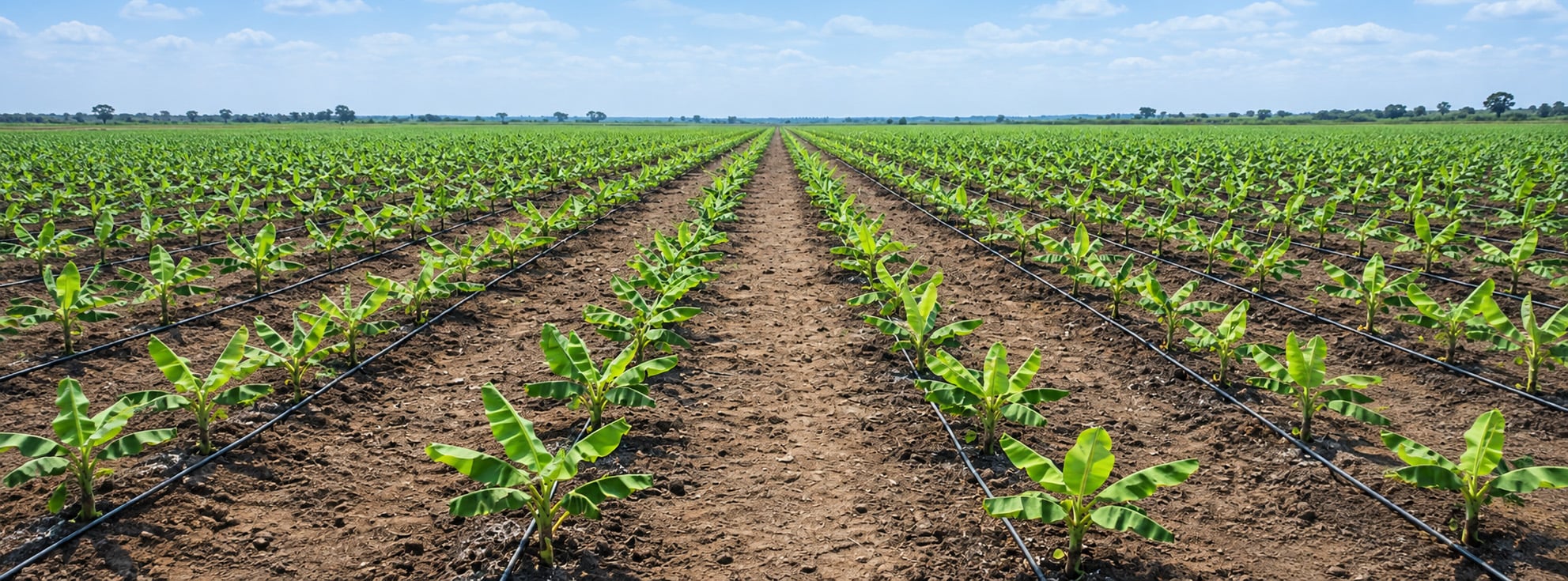
Water-soluble fertilizer for banana lets you feed the crop through drip in small doses that follow each growth stage, and in trials this gave more fruit from less fertilizer and water than soil-applied fertilizer. The best water-soluble fertilizer for banana is the one that dissolves cleanly in your water, matches the growth stage and costs […]
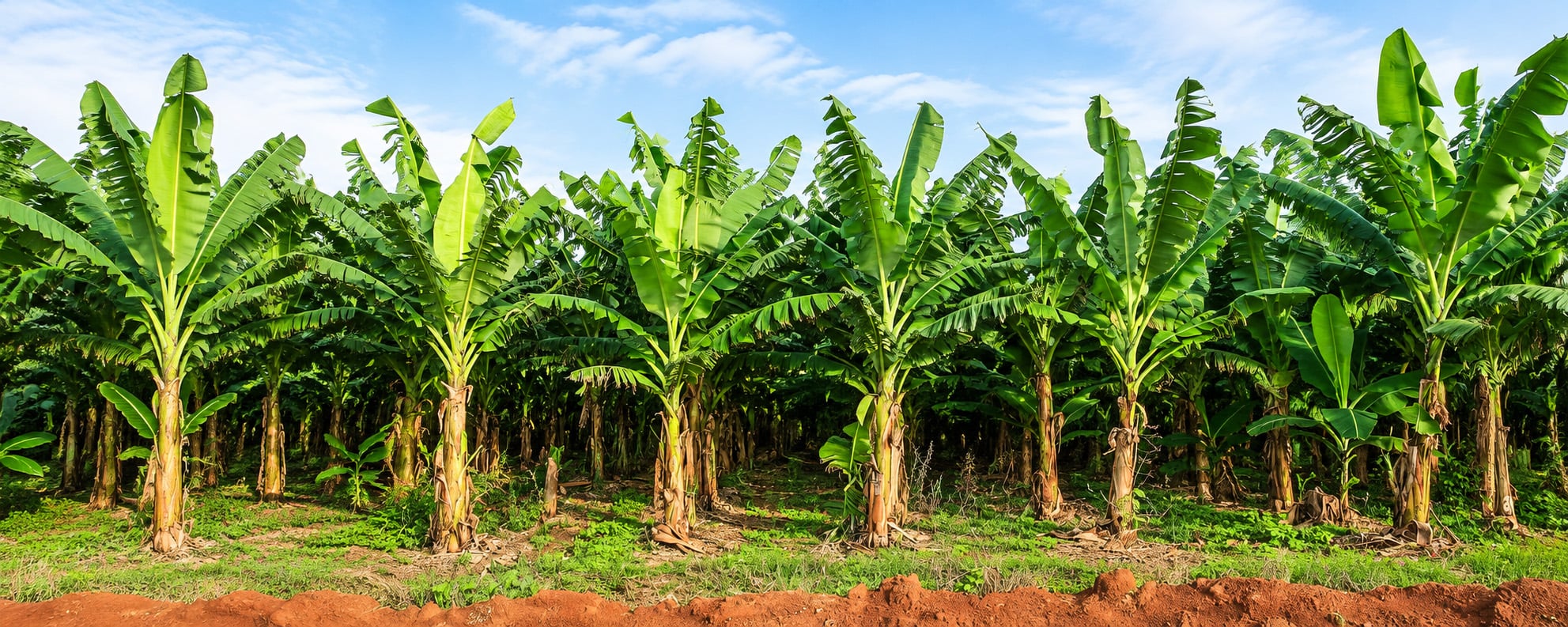
The right fertilizer for banana plants is the one that matches what the crop removes, what your soil already holds and the stage the plant is in. Banana takes up far more potassium than any other nutrient, followed by nitrogen and calcium, so K supply and timing decide much of the result. This guide covers […]
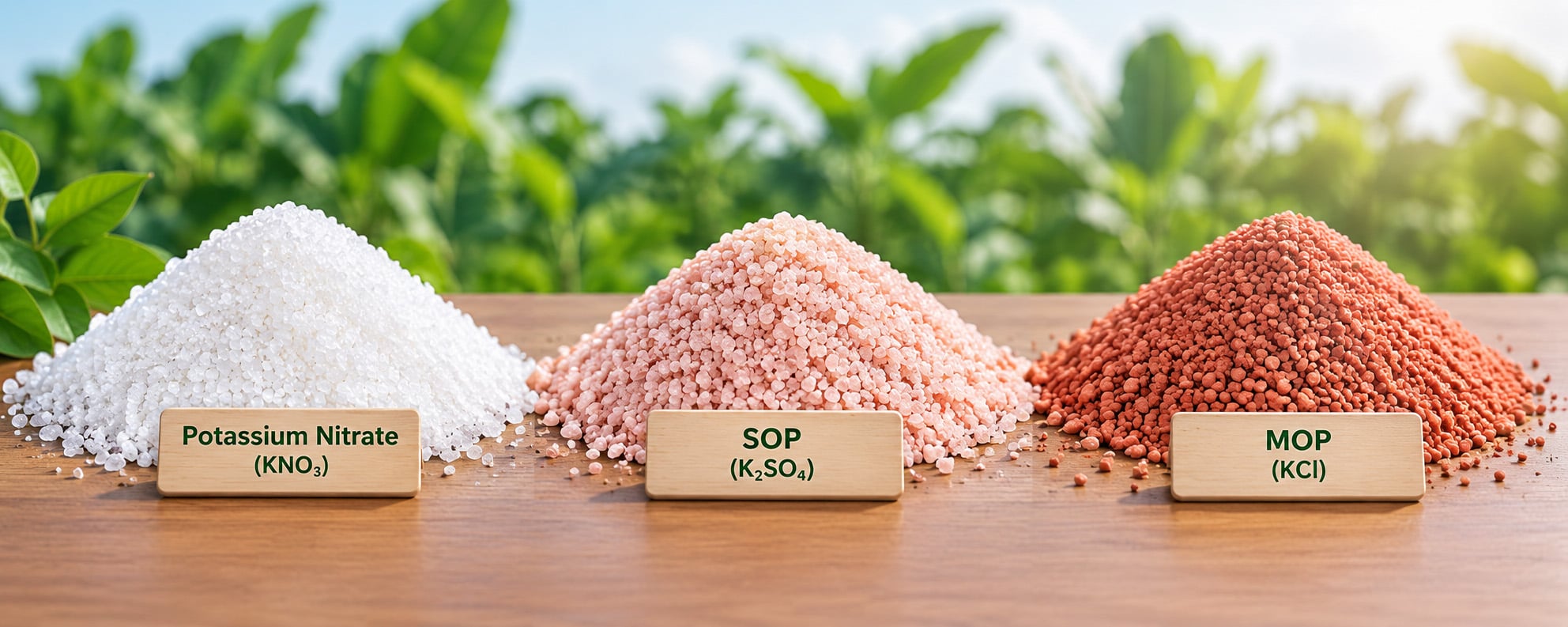
Potassium fertilizer replaces the potassium (K) your crop takes from the soil faster than the soil can release it. After nitrogen, potassium is the nutrient plants need in the largest amounts (Zörb et al., 2014), mainly to move water and sugars and to keep their cells working under stress. The common sources (muriate of potash, […]