







Banana Fertilizer Schedule by Growth Stage: Plant Crop, Ratoon and Fertigation
A good banana fertilizer schedule front-loads nitrogen and phosphorus in the first months after planting, then keeps potassium high from flower initiation through bunch filling. This guide shows how to split N, P and K across the growth stages of a plant crop, how a ratoon program differs, and how to run the same schedule […]


A good banana fertilizer schedule front-loads nitrogen and phosphorus in the first months after planting, then keeps potassium high from flower initiation through bunch filling. This guide shows how to split N, P and K across the growth stages of a plant crop, how a ratoon program differs, and how to run the same schedule through drip fertigation. Every share and rate comes from a published trial or crop guide, so you can check it and adapt it to your own soil and leaf tests.
For the bigger picture on banana nutrient demand, soil pH and leaf analysis standards, start with our Fertilizer for banana plants: nutrient needs, rates and growth-stage guide.
Banana fertilizer schedule at a glance
The table sets out what to feed at each stage of a plant crop. Timings are for Cavendish types under tropical conditions; slower cultivars and cooler sites shift every stage later.
| Stage (plant crop) | Approximate timing | What the plant is doing | Nutrient focus | How to apply |
| Before planting | Land preparation | Roots will grow into the soil you prepare now | Lime to correct pH; P worked into the soil | Incorporate lime and P before planting (Robinson & Galán Saúco, 2010) |
| Establishment | 0–2 months after planting | Small root system, fast new leaves | N and P in small doses; some K | Wide band around the plant or weekly fertigation |
| Vegetative growth | 3–6 months | Builds leaf area and the reserves the bunch will draw on | Peak N and P; K rising | Most frequent splits of the cycle |
| Flower initiation to shooting | About 5–8 months | Bunch is formed inside the pseudostem | K at its highest share; N continues | Keep K supply steady; check leaf analysis |
| Bunch filling | Shooting to harvest | Fruit fills, partly from stored K | K continues; little or no P | Continue K; last N before or around shooting |
| Ratoon cycles | Year 2 onward | Plants at every stage on the same mat | Adjust to yield, season and leaf analysis | Equal or seasonal splits through the year |
Timings are for a Cavendish plant crop and shift with cultivar and climate. Sources: Robinson & Galán Saúco (2010); Pawar & Dingre (2013); Balamohan et al. (2015).
Two rules sit behind the table. Nitrogen does not build up in the plant, so it is best given little and often: in the humid tropics, N is applied by hand eight times a year or more, and fertigation allows weekly or even daily N (Robinson & Galán Saúco, 2010). Potassium does build up in the plant and is not leached as easily, so it can go on less often in larger doses, while phosphorus is usually applied once, before planting (Robinson & Galán Saúco, 2010).
How much N, P and K does banana need? The NPK ratio for banana
Banana is a potassium crop. A crop yielding about 50 t/ha removes 189 kg N, 29 kg P and 778 kg K per hectare in its fruit alone (Lahav & Turner, 1983, and Lahav, 1995, in Robinson & Galán Saúco, 2010). Expressed the way fertilizer bags are labeled, that is roughly 1 part N to 0.35 parts P2O5 to 5 parts K2O. Published programs land in a similar place:
| Program or study | Setting | Rate as reported | N : P2O5 : K2O |
| Nutrients removed in fruit | About 50 t/ha | 189 kg N, 29 kg P, 778 kg K/ha | 1 : 0.35 : 5.0 |
| Stage-wise trial, Grand Naine (Balamohan et al., 2015) | Tamil Nadu, India, drip | 165 : 52.5 : 495 g per plant (as reported) | 1 : 0.32 : 3.0 |
| Uptake-based plan (Zhang et al., 2025) | Guangdong, China | 195 : 58.5 : 450 g per plant | 1 : 0.3 : 2.3 |
| Local farmer practice in the same trial (Zhang et al., 2025) | Guangdong, China | 240 : 300 : 360 g per plant | 1 : 1.25 : 1.5 |
| Subtropical target, 20 t/ha (Weinert & Simpson, 2016) | New South Wales, Australia | 100 kg N, 20 kg P, 220 kg K/ha per year | 1 : 0.46 : 2.6 |
| High-yield programs (Robinson & Galán Saúco, 2010) | Costa Rica (N); South Africa and New South Wales (K) | 300–450 kg N/ha; 600–800 kg K/ha per year | K2O about 1.5 to 3 times N |
Fruit removal from Lahav & Turner (1983) and Lahav (1995), in Robinson & Galán Saúco (2010), Table 9.1. Elemental P and K converted to oxides (P × 2.29; K × 1.205) so the ratios compare like with like.
So what is the best NPK for banana? Across these programs, the annual N:P2O5:K2O ratio sits around 1 : 0.2–0.5 : 1.5–3, with more K on low-K soils and at higher yields. Annual rates vary far more than ratios do. About 150 kg N/ha is applied on heavy, low-leaching soils in South Africa, against 300–450 kg N/ha in high-rainfall Costa Rica; for about 50 t/ha in the subtropics, 600–800 kg K/ha is recommended each year, and up to 1,200 kg K/ha on K-poor soils in Israel (Robinson & Galán Saúco, 2010). Your soil test and yield target decide where you sit in those ranges.
The ratio matters as much as the total. In a Guangdong trial, local farmers applied N, P2O5 and K2O at about 1 : 1.25 : 1.5 from general compound fertilizers. A plan matched to the crop’s measured uptake (1 : 0.3 : 2.3) used about a fifth of the phosphate, raised yield by 7.0% and raised P use efficiency by 94.9% (Zhang et al., 2025). It was a single-season trial, but it shows the usual gap: too much P and too little K.
Under drip in southern China, yield rose with K up to 675 kg K2O/ha (45.1 t/ha) and fell by 5.4% at 900 kg K2O/ha (Zheng et al., 2022). The site also received 750 kg N and 450 kg P2O5 per hectare, so read it as “K pays up to a point”, not as a rate to copy. For more on reading K needs from the plant, see our guide to potassium deficiency in banana and the Potassium fertilizers: roles, sources and deficiency hub.
How to split fertilizer across growth stages
Balanced nutrition early in the vegetative stage matters most, because the developing bunch takes much of its nutrient supply, especially K, from what the plant stored before shooting (Robinson & Galán Saúco, 2010). Late starts are hard to recover: in plantains, delaying the first application by six months cut yield by 42%, even though normal fertilization followed (Obiefuna, 1984, in Robinson & Galán Saúco, 2010).
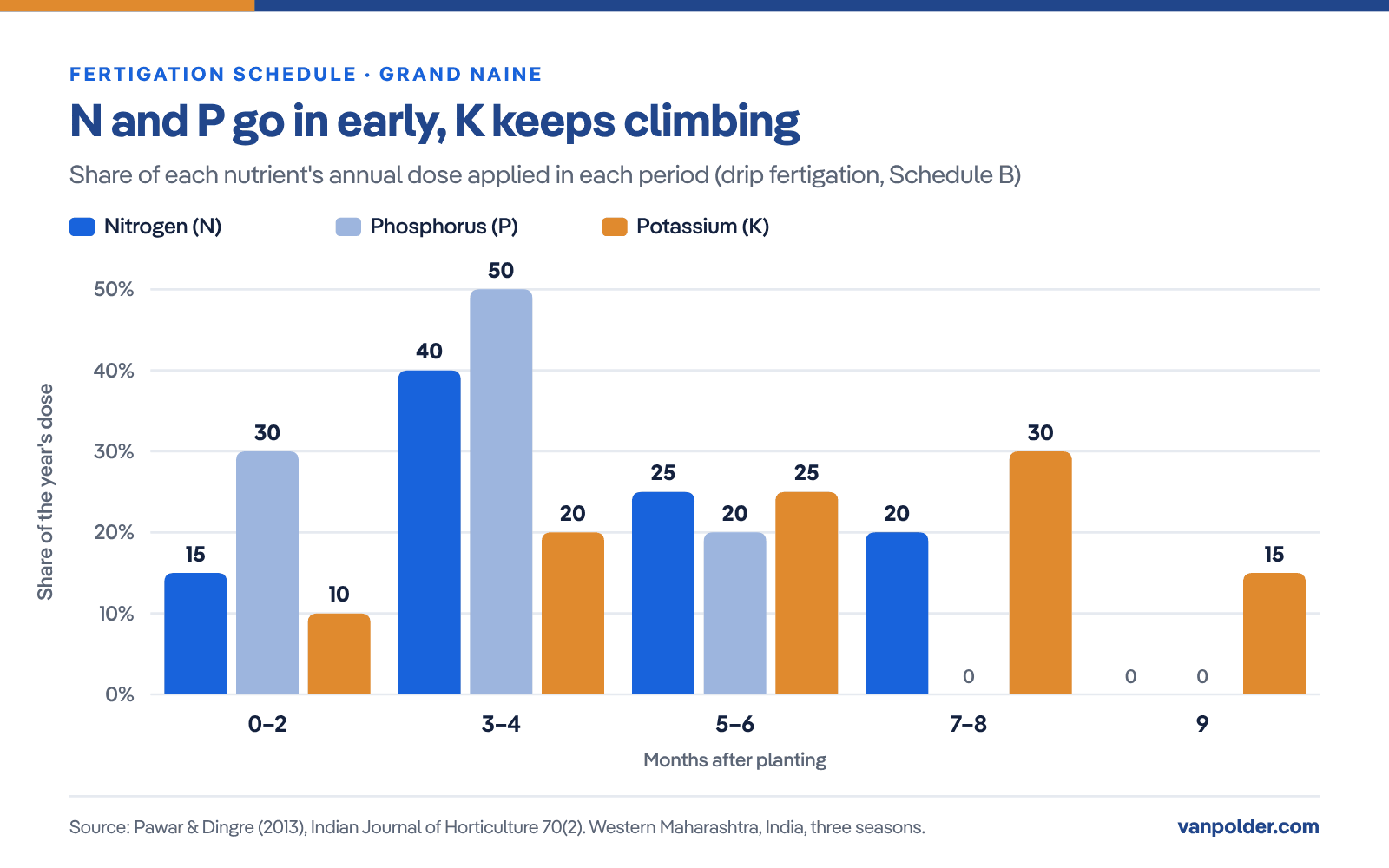
Three published schedules for a plant crop show the same pattern:
| Program | Applications | N | P | K | Source |
| Six doses, first year (Robusta) | Doses 1 to 6, evenly spaced | Same split for all nutrients (one 9:9:35 grade): 10, 15, 15, 25, 20, 15% | Twyford & Walmsley, 1974 | ||
| Drip fertigation, Schedule B (Grand Naine) | Months 0–2, 3–4, 5–6, 7–8, 9 | 15, 40, 25, 20, 0% | 30, 50, 20, 0, 0% | 10, 20, 25, 30, 15% | Pawar & Dingre, 2013 |
| Four critical stages (Grand Naine) | Months 3, 5, 7, 9 after planting | 40, 30, 30, 0% | 100, 0, 0, 0% | 25, 35, 25, 15% | Balamohan et al., 2015 |
Percentages are shares of each nutrient’s annual dose. All three programs put N and P early and keep K going until bunch filling.
The Schedule B program in the chart gave 82.9 t/ha with 100% of the recommended dose as water-soluble fertilizer through drip, against 57.4 t/ha under surface irrigation with conventional fertilizer, over three seasons with Grand Naine (Pawar & Dingre, 2013). In the Tamil Nadu trial, splitting 100% of the recommended dose over four critical stages gave the heaviest bunches (32.15 kg) and the best cost:benefit ratio (1 : 3.97) of 19 treatments (Balamohan et al., 2015).
Read together, the schedules point to a practical rule for the plant crop:
- Put all or most of the P in before planting or in the first 4 to 6 months.
- Give most of the N (70–80% in these trials) by about month 6, and taper N to zero around shooting.
- Build K steadily, with its largest share between flower initiation and early bunch filling.
For stage-specific detail, see Tissue-culture plantlet establishment and rooting nutrition, Vegetative stage nutrition: planting to shooting and Bunch filling: nutrition from shooting to harvest.
Plant crop vs ratoon: how the program changes
The first year has to feed both the plant crop and the first ratoon sucker growing beside it. The second year still needs high rates, because the first ratoon is a larger plant with a bigger bunch, and small plant-crop pseudostems leave little to recycle. From the second ratoon on, needs should gradually fall as large harvested pseudostems return nutrients to the mat (Robinson & Galán Saúco, 2010). Recycling is substantial: after 10 weeks, up to 40% of the nutrients a sucker needs to mature have come from the mother plant (Weinert & Simpson, 2016).
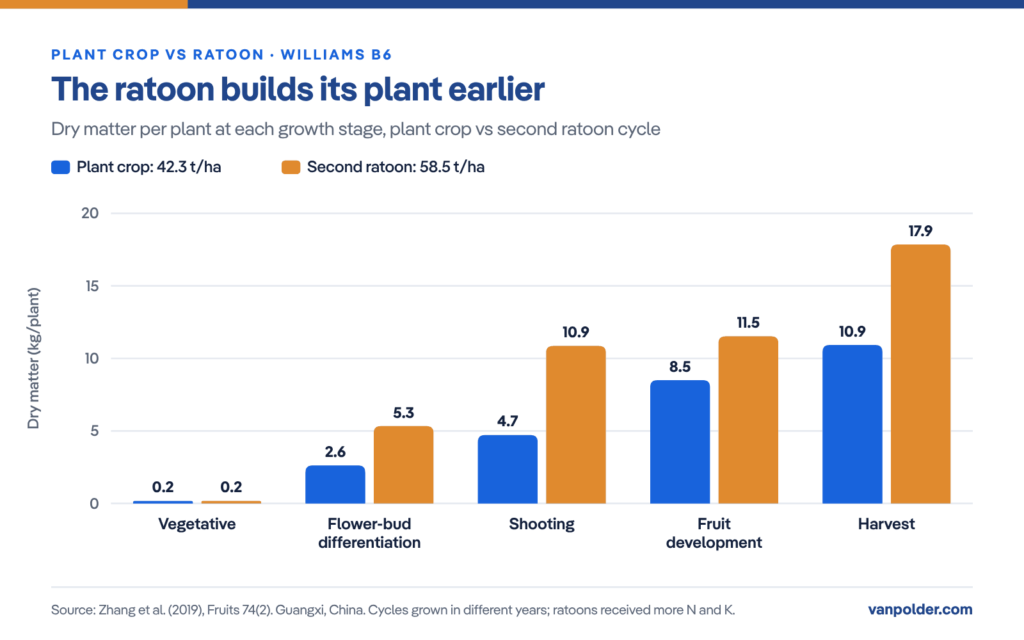
Ratoons also shift their timing. In a Williams B6 plantation in Guangxi, the second ratoon cycle held twice the dry matter of the plant crop at flower-bud differentiation (5.3 vs 2.6 kg per plant) and yielded 58.5 t/ha against 42.3 t/ha (Zhang et al., 2019). The authors put the key feeding window at shooting to fruit development for the plant crop, but earlier, at flower-bud differentiation to shooting, for ratoons, with about 30–40% of the total fertilizer applied in that window (Zhang et al., 2019). The cycles were grown in different years and the ratoons received more N and K, so treat this as a pattern, not proof that ratoons always need more.
Older guidance went further the other way. Calculating from plant composition, Twyford & Walmsley (1974) proposed cutting fertilizer in ratoon years by 87% because ratoons feed largely on residues. That figure assumes no losses, and current guides keep ratoon rates high until at least the second ratoon (Robinson & Galán Saúco, 2010). Use leaf analysis, not a fixed cut, to bring rates down.
Once a plantation is in ratoon, plants on the same mat are at every stage at once, so you can no longer feed by plant stage. Feed by season instead: apply more when growing conditions are good and less when they are poor (Robinson & Galán Saúco, 2010). Temperature is the main driver; whole-plant concentrations of most nutrients fell when temperatures dropped below 29/22 °C day/night (Lahav & Turner, 1985, in Robinson & Galán Saúco, 2010). In the tropics, dry months that slow growth deserve the same caution. Twyford & Walmsley (1974) suggested equal applications three or four times a year after the first year; on leached soils with heavy rain, N needs more frequent splits (Robinson & Galán Saúco, 2010). Under fertigation, keep weekly doses and adjust them by month.
Banana fertigation schedule
Fertigation in banana is the most efficient way to place fertilizer, because nutrients reach the roots with the water that carries them (Robinson & Galán Saúco, 2010). Efficient fertigation can cut annual N and K rates by up to 25% (Weinert & Simpson, 2016). The table converts Schedule B into weekly shares, so you can set it against your own annual target:
| Period (months after planting) | N per period | N per week | P per period | P per week | K per period | K per week |
| 0–2 | 15% | 1.7% | 30% | 3.4% | 10% | 1.1% |
| 3–4 | 40% | 4.6% | 50% | 5.7% | 20% | 2.3% |
| 5–6 | 25% | 2.9% | 20% | 2.3% | 25% | 2.9% |
| 7–8 | 20% | 2.3% | 0% | 0% | 30% | 3.4% |
| 9 | 0% | 0% | 0% | 0% | 15% | 3.5% |
Period shares from Pawar & Dingre (2013), Schedule B. Weekly figures are the period share divided by about 8.7 weeks (two months) or 4.3 weeks (month 9), as a percentage of the annual dose of that nutrient.
As an example, with an annual target of 300 kg N/ha, months 3–4 get 40%, or 120 kg N/ha: about 14 kg N/ha per week. Work out P and K the same way from their own annual targets.
Nitrogen form under drip
Under drip on a calcareous soil (pH 7.5) in the Jordan Valley, urea and ammonium nitrate gave faster growth and higher yields than potassium nitrate as the N source at equal N, P and K, which the authors linked to a steadier balance of nitrate and ammonium N (Israeli et al., 1985). Regular N fertilizer and irrigation also lower soil pH over time (Robinson & Galán Saúco, 2010). A program that mixes nitrate and ammonium N, with soil pH checked each year, covers both points. On pH correction, see Soil pH and liming for banana soils.
Two stock tanks
Calcium nitrate is incompatible with phosphate and sulfate solutions (UC Agriculture and Natural Resources, n.d.), so most banana fertigation systems use two stock tanks:
| Tank A | Tank B | Why |
| Calcium nitrate, calcium-magnesium nitrate | Phosphates (MKP, MAP, NPK grades with P) | Calcium and phosphate form insoluble calcium phosphate |
| Calcium nitrate, calcium-magnesium nitrate | Sulfates (potassium sulfate, magnesium sulfate) | Calcium and sulfate form gypsum, which settles and blocks filters |
| Potassium nitrate, magnesium nitrate | Potassium nitrate can also go here | Compatible with both tanks |
Based on UC Agriculture and Natural Resources (n.d.): calcium nitrate is incompatible with phosphate and sulfate solutions. Run a jar test with your own water before mixing new products.
To choose grades for each tank and stage, see Choosing water-soluble fertilizers for banana fertigation.
Banana fertilizer schedule in the Philippines
The Philippine Code of Good Agricultural Practices for banana prefers drip and under-tree micro-irrigation to overhead sprinklers, asks that fertilizer be applied based on soil and/or leaf analysis, and requires records of each application (BAFS, 2013). A fertigation program built on a soil test and adjusted by leaf analysis meets all three.
For Saba, the government production guide sets a mix of 14-14-14, urea and muriate of potash every 4 months, with the rate doubled from the second year (BPI, n.d.). In a field trial on acid Jasaan soil (pH 3.9–5.2) in Misamis Oriental, Saba yield rose from 7.8 t/ha without fertilizer to 11.0 t/ha at the highest NPK level tested, 270-180-540 g per mat as reported; only that level differed significantly from no fertilizer (Ohagan et al., 2023). On soils this acid, correcting pH first is part of the schedule.
For Cavendish plantations in Mindanao, the same stage split applies, with ratoon rates set by leaf analysis and the K:Mg balance of the soil. See Soil and leaf analysis for banana for sampling.
Van Polder products for banana fertilizer programs
Match the grade to the stage:
- Establishment and early vegetative growth: WSF NPK 20-20-20+TE supplies N in nitrate, ammonium and urea forms with P, K and trace elements. For urea-free programs, use WSF NPK 19-19-19+TE, or WSF NPK 13-40-13+TE where early P is needed.
- Phosphorus and potassium without nitrogen: MKP 0-52-34 fits the early P window and late-stage programs where you want to stop N (Tank B).
- Flower initiation and bunch filling: WSF NPK 15-5-40+TE carries the high K share with some N. Potassium nitrate 13-0-45+ME supplies K and N at about 3:1, a ratio well suited to banana (Robinson & Galán Saúco, 2010). In the Philippines, potassium nitrate is a regulated product, so check availability with your distributor.
- Calcium and magnesium (Tank A): WSF CamagN supplies Ca and Mg with nitrate N. Keep it apart from phosphates and sulfates.
For rates, follow each product label and adjust to your soil and leaf tests. To compare K sources, see Potassium nitrate vs SOP vs MOP for bananas.
FAQ
What is the best NPK ratio for banana?
Published programs apply roughly 1 part N to 0.2–0.5 parts P2O5 to 1.5–3 parts K2O per year (Table 2). Shift toward the top of the K range on low-K soils and at high yields, and confirm with leaf analysis.
Is 10-10-10 fertilizer good for banana trees?
A balanced grade such as 10-10-10 works as a starter, when the plant needs N and P. For a full program it supplies far more P and far less K than the crop removes (Robinson & Galán Saúco, 2010), so switch to a high-K grade from the vegetative stage onward.
How often should you fertilize bananas?
By hand, N is applied eight or more times a year in the humid tropics; under fertigation, weekly or even daily (Robinson & Galán Saúco, 2010). K can go on less often in larger doses, and P usually once before planting.
Is there a banana fertilizer schedule PDF?
Tables 1, 3 and 4 on this page are the schedule. Print them, or save the page as a PDF, and fill in your own annual targets from your soil test.
Next step
Set your annual N, P and K targets from a soil test and your yield goal, split them with the stage shares above, and check the result with leaf analysis twice a year. If you want help choosing water-soluble grades for each stage, contact a Van Polder distributor.
Sources
- Robinson, J.C. & Galán Saúco, V. (2010). Bananas and Plantains, 2nd edition. Crop Production Science in Horticulture 19. CABI, Wallingford. ISBN 978-1-84593-658-7.
- Pawar, D.D. & Dingre, S.K. (2013). Influence of fertigation scheduling through drip on growth and yield of banana in western Maharashtra. Indian Journal of Horticulture 70(2): 200–205. journal.iahs.org.in
- Balamohan, T.N., Auxilia, J. & Sudha, R. (2015). Standardization of stage-wise requirement of nutrients in banana cv. Grande Naine (AAA). Journal of Horticultural Sciences 10(2): 165–171. jhs.iihr.res.in
- Twyford, I.T. & Walmsley, D. (1974). The mineral composition of the Robusta banana plant IV. The application of fertilizers for high yields. Plant and Soil 41: 493–508. https://doi.org/10.1007/BF02185811
- Zhang, J., Wang, C., Fang, Z., Li, B., Christie, P. & Li, X. (2019). Nutrient and dry matter accumulation in different generations of banana at different growth stages. Fruits 74(2): 82–92. https://doi.org/10.17660/th2019/74.2.4
- Zhang, X., Zhao, L., Huang, Q., Pang, B., Zhou, Z. & Lu, Y. (2025). Synchronized fertilization based on crop nutrient uptake and fertilizer nutrient release characteristics increases nutrient use efficiency in banana. Scientific Reports 15: 34449. https://doi.org/10.1038/s41598-025-17602-0
- Zheng, C., Yang, X., Liu, K. & Huang, Y. (2022). Effects of different potassium supply levels on potassium fertilizer of bananas under drip irrigation. Applied Engineering in Agriculture 38(1): 155–163. https://doi.org/10.13031/aea.14905
- Weinert, M. & Simpson, M. (2016). Subtropical banana nutrition: matching nutrition requirements to growth demands. NSW Department of Primary Industries. ISBN 978-1-74256-984-0. horticulture.com.au
- Israeli, Y., Hagin, J. & Katz, S. (1985). Efficiency of fertilizers as nitrogen sources to banana plantations under drip irrigation. Fertilizer Research 8: 101–106. https://doi.org/10.1007/BF01048893
- UC Agriculture and Natural Resources (n.d.). Interactions which can cause precipitation. Maintenance of microirrigation systems. ucanr.edu
- Bureau of Agriculture and Fisheries Standards (2013). PNS/BAFS 129:2013 Code of Good Agricultural Practices for Banana Production. Department of Agriculture, Philippines. ppssd.buplant.da.gov.ph
- Bureau of Plant Industry (n.d.). Saba Banana Production Guide. Department of Agriculture Regional Field Office 10. cagayandeoro.da.gov.ph
- Ohagan, J.M., Harnaiz, L.L.A., Nagal, C.J.C., Taylaran, R.D. & Gonzaga, A.B. Jr. (2023). Productivity of ‘Saba’ banana (Musa acuminata x balbisiana) as influenced by different levels of NPK fertilizer under Jasaan soil series. Mindanao Journal of Science and Technology 21(1): 186–201. https://mjst.ustp.edu.ph/index.php/mjst/article/view/1516


Maharashtra has declared drought in 265 talukas after a weak monsoon, and grape growers in Nashik fear losing at least 40% of this season’s harvest. For anyone supplying fruit growers in India, the next few months are about keeping crops and vines alive and productive with very little water. At Van Polder, we believe drought […]

Denmark’s new nitrogen regulation starts on 1 January 2027, but vegetable growers and several fruit, berry and nursery crops will stay on today’s nitrogen norms for one more year. For anyone supplying high-value horticulture, this is a short pause, not a change of direction. At Van Polder, we believe nitrogen efficiency will matter more every […]
Retailers in the United States report that growers are trimming micronutrient spending this season, while tissue tests keep finding zinc, boron and manganese shortages. At Van Polder, we believe this is the wrong place to save, and the lesson applies to every market our partners serve. When nitrogen, phosphate and potash bills rise, micronutrient fertilizer […]
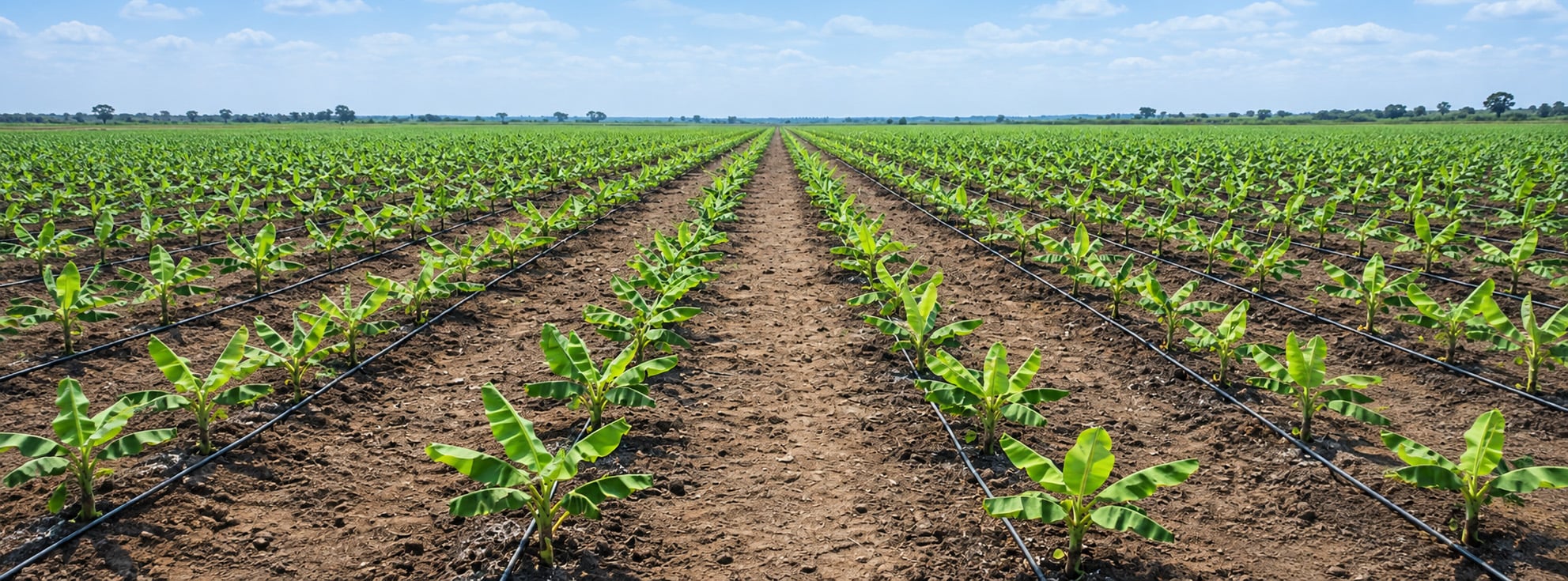
Water-soluble fertilizer for banana lets you feed the crop through drip in small doses that follow each growth stage, and in trials this gave more fruit from less fertilizer and water than soil-applied fertilizer. The best water-soluble fertilizer for banana is the one that dissolves cleanly in your water, matches the growth stage and costs […]
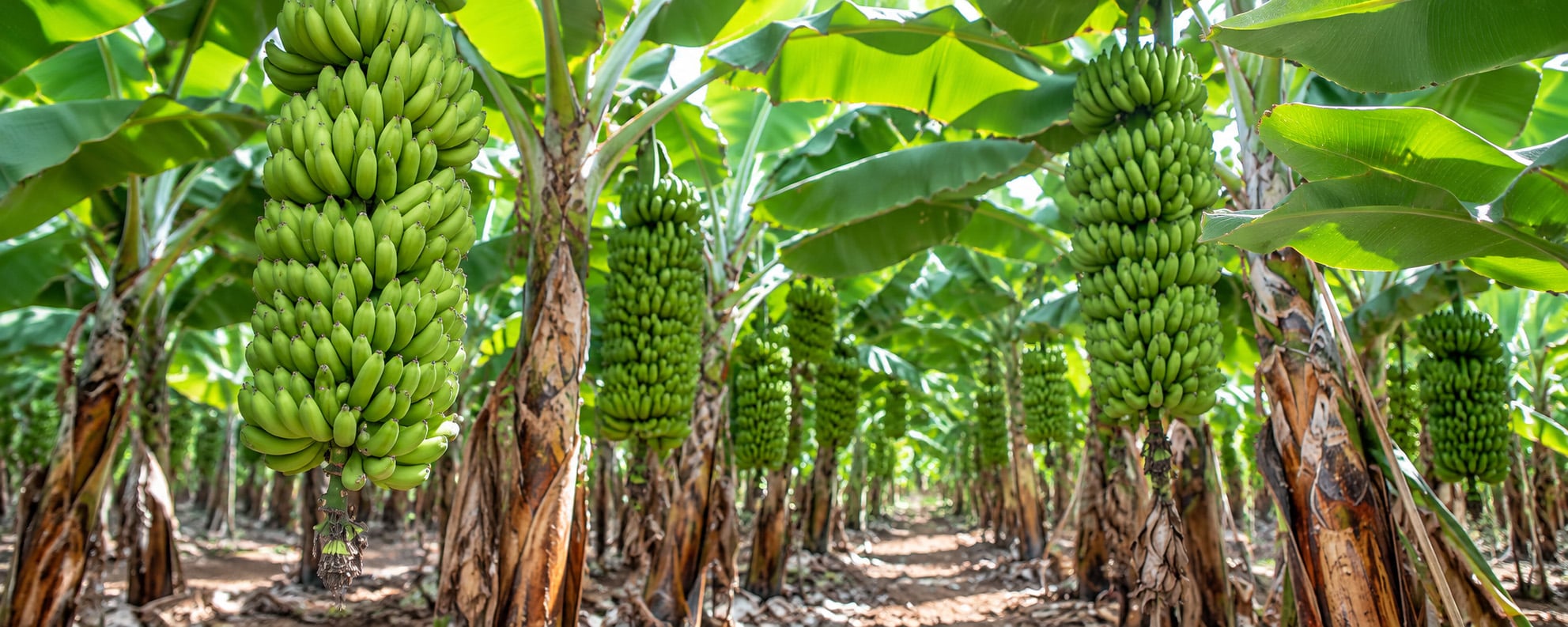
To increase banana bunch weight, build a large, healthy leaf canopy and good potassium reserves before the bunch emerges, keep water supply steady, and protect the leaves until harvest. Most of the bunch’s potential is set before shooting: the number of fruits depends on the leaf area the plant has when it initiates its flower […]
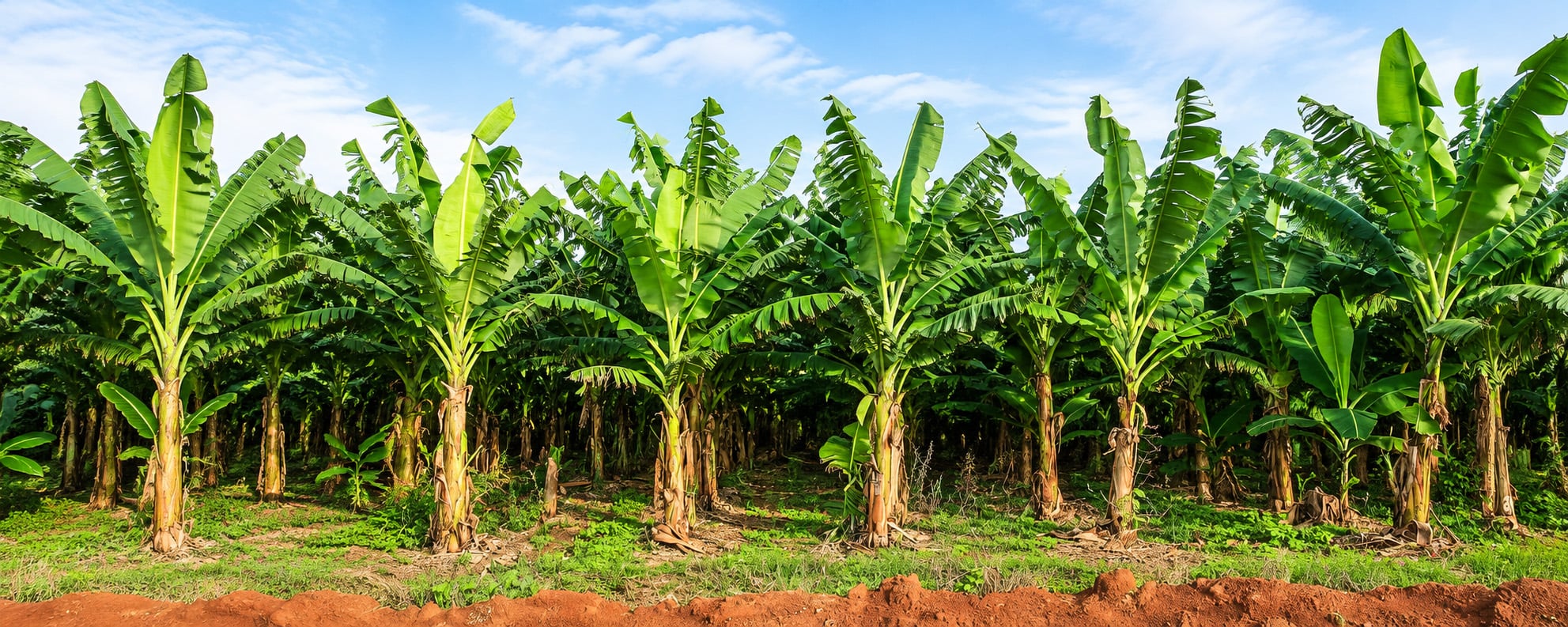
The right fertilizer for banana plants is the one that matches what the crop removes, what your soil already holds and the stage the plant is in. Banana takes up far more potassium than any other nutrient, followed by nitrogen and calcium, so K supply and timing decide much of the result. This guide covers […]