







Potash for Banana Plants: Potassium Nitrate vs SOP vs MOP
Muriate of potash (MOP), sulfate of potash (SOP) and potassium nitrate all supply the potassium a banana crop needs, so the best potash for banana plants depends on your water, soil, application method and budget, not on the potassium itself. MOP is the cheapest and most widely used source; SOP adds the least salt and […]


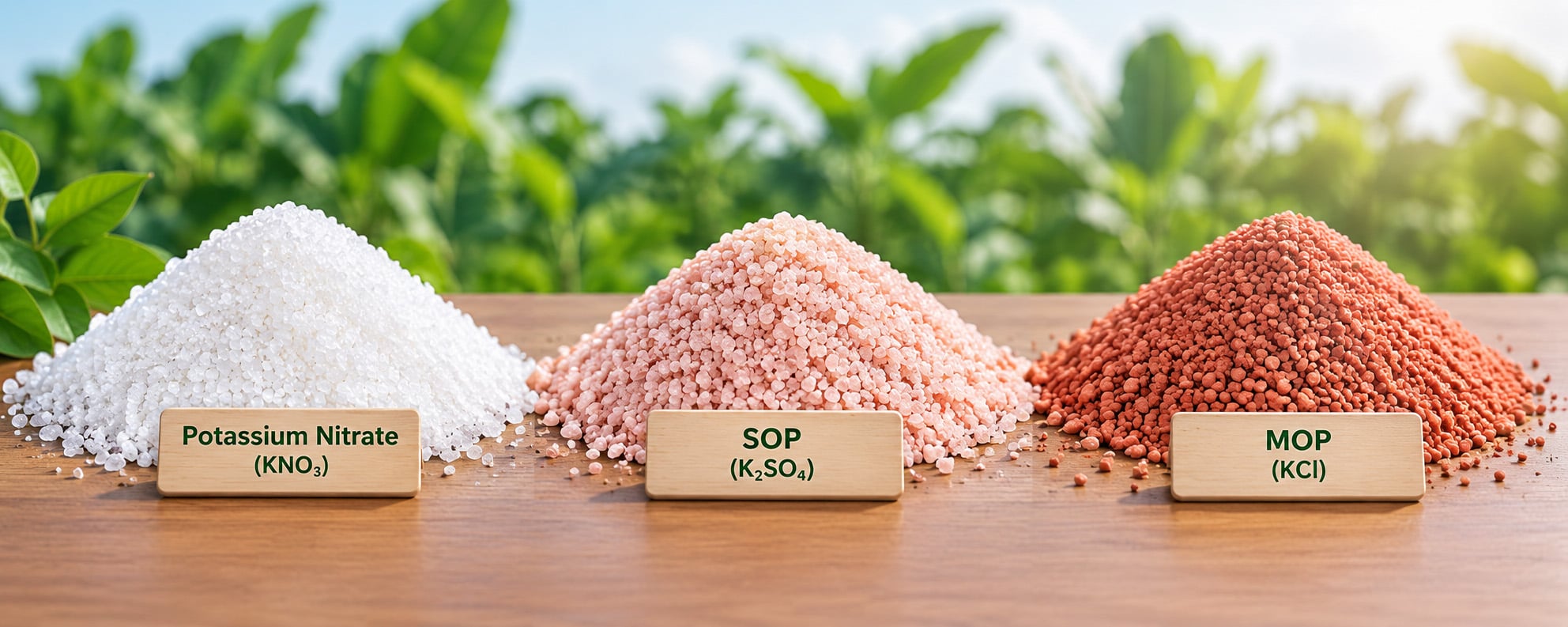
Muriate of potash (MOP), sulfate of potash (SOP) and potassium nitrate all supply the potassium a banana crop needs, so the best potash for banana plants depends on your water, soil, application method and budget, not on the potassium itself. MOP is the cheapest and most widely used source; SOP adds the least salt and supplies sulfur; potassium nitrate dissolves well and brings nitrate nitrogen. This guide compares the three on the points that decide the choice and shows where each one fits.
For how much potassium banana needs and when, see the Fertilizer for banana plants guide and our banana fertilizer schedule.
Why the potassium source matters for banana
Banana takes up more potassium than any other nutrient, and the rates are large: for a crop of about 50 t/ha in the subtropics, 600–800 kg K/ha is recommended each year (Robinson & Galán Saúco, 2010). At those rates, whatever comes with the potassium (chloride, sulfur or nitrogen) is applied in large amounts too. When you choose potassium for banana plants, remember that the plant takes up the same potassium ion from all three sources; the differences lie in the partner ion, salt load, solubility and price. For signs that a crop is short of potassium, see potassium deficiency in banana.
MOP vs SOP vs potassium nitrate at a glance
| Muriate of potash (MOP, KCl) | Sulfate of potash (SOP, K2SO4) | Potassium nitrate (KNO3) | |
| Potassium (as K2O) | About 60% | 48–53% | About 46% |
| What else it supplies | Chloride (about 45%) | Sulfur (17–18%) | Nitrate nitrogen (about 13%) |
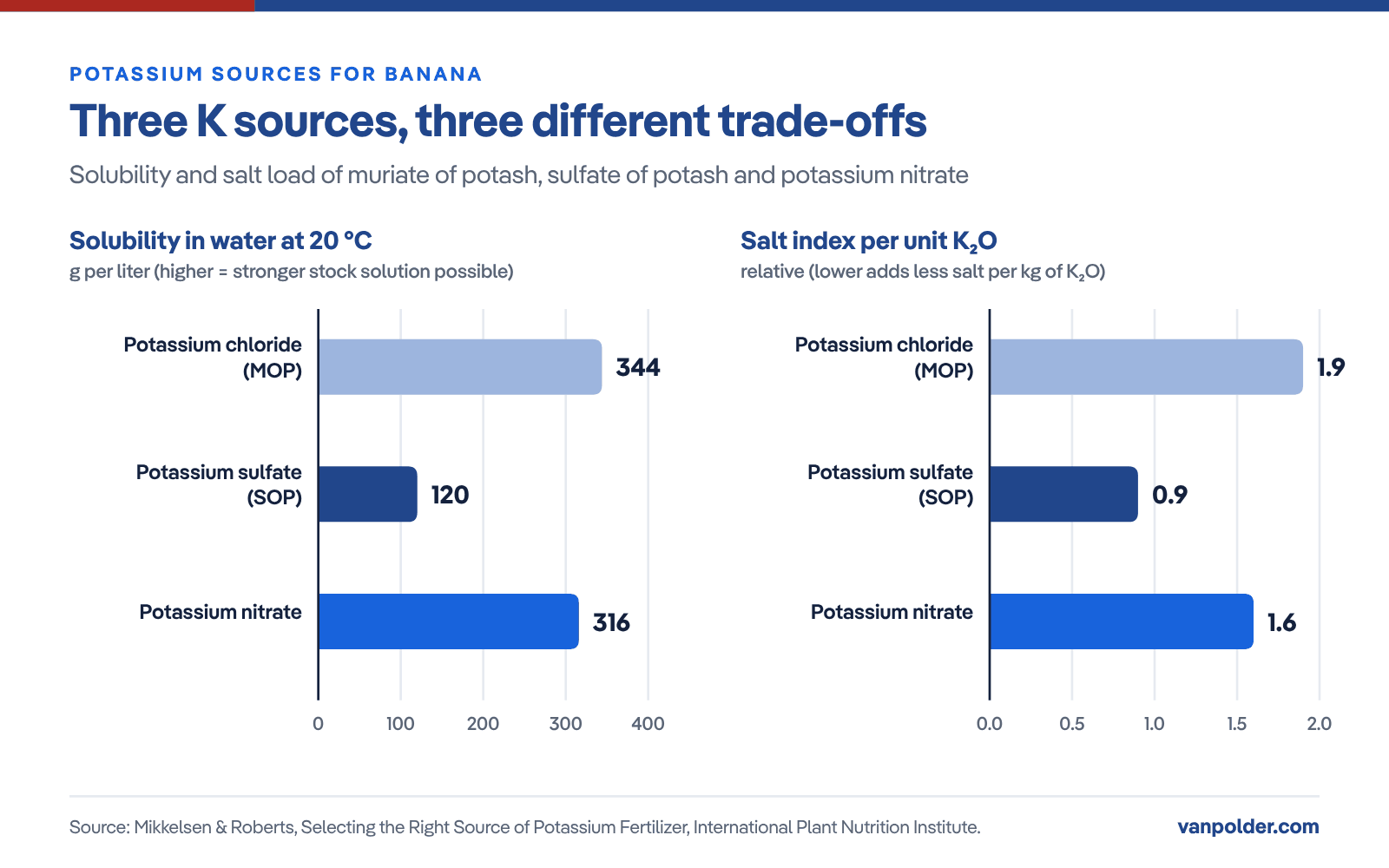
| Solubility at 20 °C | 344 g/L | 120 g/L | 316 g/L |
| Salt index per unit K2O | 1.9 (highest) | 0.9 (lowest) | 1.6 |
| Cost | Cheapest and most widely used | Higher than MOP | Highest |
Sources: Mikkelsen & Roberts (IPNI); Borges & Souza (2009) for chloride content; Robinson & Galán Saúco (2010) for cost ranking.
Muriate of potash (MOP) for banana
Muriate of potash, or potassium chloride, is the cheapest and most common potassium source for banana (Robinson & Galán Saúco, 2010). It carries about 60% K2O (Mikkelsen & Roberts, IPNI), so fewer bags are needed per kilogram of potassium, and it dissolves well: 344 g/L at 20 °C. In Brazil it is also the main potassium source used in banana fertigation (Pinto, 2008).
The trade-off is chloride. MOP contains about 45% chloride (Borges & Souza, 2009), and it has the highest salt index of the three sources per unit of K2O (Mikkelsen & Roberts, IPNI). Chloride toxicity can occur over time (Robinson & Galán Saúco, 2010), and banana is rated sensitive to salinity in FAO’s crop salt tolerance data (Tanji & Kielen, 2002). In a drip trial in Israel, irrigation water at 3.6 dS/m cut bunch weight by 31%, and roots held about 3.3% chloride when damage appeared, with no visible leaf symptoms (Israeli et al., 1986). That trial tested salty water, not MOP, but it shows why the salt load adds up where chloride cannot leach away.
In practice, the risk depends on the site. Where rainfall is high and drainage good, MOP is a sound, economical choice. Where irrigation water is already salty, an Embrapa guide for banana fertigation advises replacing potassium chloride once the water’s electrical conductivity exceeds 1.0 dS/m (Pinto, 2008). Test your water before deciding; see Irrigation water quality for banana fertigation.
Sulphate of potash for banana (SOP)
Sulfate of potash (often spelled sulphate of potash) supplies 48–53% K2O and 17–18% sulfur, and has the lowest salt index of the three sources (Mikkelsen & Roberts, IPNI). That makes it the safer choice where salinity is a concern, and the sulfur is useful: banana uses sulfur in amino acids, proteins and chlorophyll, and takes up most of it between sucker selection and bunching (Weinert & Simpson, 2016).
Its limit is solubility: only 120 g/L at 20 °C (Mikkelsen & Roberts, IPNI), so stock solutions must be weaker and take longer to dissolve. Choose a fully soluble, fertigation grade for drip systems, and keep it apart from calcium nitrate in the stock tank, because calcium and sulfate form gypsum (UC Agriculture and Natural Resources, n.d.).
Field evidence on SOP versus MOP in banana is limited. In a one-season trial with Robusta in India, SOP at the same potassium dose as MOP gave heavier bunches: 29.0 kg against 27.1 kg (Alagarsamy & Kumar, 2008). Plants given no potassium still produced 26.8 kg bunches, so the soil supplied much of the crop’s potassium, and the trial was supported by a potash company. Treat it as one encouraging result, not proof. As a foliar spray after shooting, SOP at 1.5% applied twice raised bunch weight in another Robusta trial (Ramesh Kumar et al., 2008). For more on feeding the bunch, see Bunch filling: nutrition from shooting to harvest.
Potassium nitrate for banana
Potassium nitrate supplies about 46% K2O and 13% nitrogen, all as nitrate, with no chloride (Mikkelsen & Roberts, IPNI). It supplies potassium and nitrogen at about 3:1, a ratio well suited to banana, but it is the most expensive of the three (Robinson & Galán Saúco, 2010). With a solubility of 316 g/L at 20 °C (Mikkelsen & Roberts, IPNI), it suits drip fertigation in the high-K stages from flowering to bunch filling.
The nitrogen form needs some context. A review of Fusarium wilt research notes that nitrate has been associated with lower disease pressure and ammonium with higher, while consistent evidence on potassium itself is lacking (Dita et al., 2018); this is an association, and no fertilizer controls Fusarium wilt. Under drip on a calcareous soil, urea and ammonium nitrate gave higher yields than potassium nitrate as the nitrogen source, which the authors linked to a better nitrate–ammonium balance (Israeli et al., 1985). So use potassium nitrate as part of a program with a mix of nitrogen forms, not as the only nitrogen source. On nutrition in Fusarium wilt areas, see Nutrition and soil health in Fusarium wilt (TR4) areas.
In the Philippines, potassium nitrate is regulated: a permit to purchase is required from the PNP Firearms and Explosives Office under Republic Act 9516, and only FPA-licensed entities may import nitrates (Fertilizer and Pesticide Authority, 2022). Check availability and paperwork with your distributor.
Best potassium fertilizer for banana: which source when
| Situation | Best fit | Why |
| Rainfed or high-rainfall plantation, good drainage, fresh water | MOP | Lowest cost per kg of K; chloride is easily leached where rainfall is high |
| Saline irrigation water (EC above about 1 dS/m), dry season, poor drainage | SOP or potassium nitrate | Less or no chloride; SOP has the lowest salt index |
| Drip fertigation, high K demand from flowering to bunch filling | Potassium nitrate, or a high-K water-soluble NPK | High solubility; supplies K with nitrate N |
| Low soil sulfur, or a program with no other S source | SOP | Adds sulfur with the potassium |
| Post-shooting foliar spray | SOP (low salt index) | Used in trials at 1.5% after shooting |
| Late program where you want K without more N | SOP or MOP | No nitrogen |
General guidance; confirm with soil, water and leaf analysis. Sources as cited in the text.
Many programs combine sources: MOP as the base soil application where water and drainage allow, with potassium nitrate or SOP through the drip in the high-demand stages. Whatever the mix, keep an eye on magnesium: high potassium supply can induce magnesium deficiency in banana (Borges et al., 2025), so check the K:Mg balance in leaf analysis. See Magnesium for banana and the Ca:Mg:K balance in Davao soils.
How to compare cost per kilogram of K2O
Compare sources on the price of the nutrient, not the bag. Divide the bag price by the kilograms of K2O it contains: a 50 kg bag at 60% K2O holds 30 kg K2O, at 50% it holds 25 kg, and at 46% it holds 23 kg. Then add the value of what else the product supplies: the nitrogen in potassium nitrate replaces part of your nitrogen fertilizer, and the sulfur in SOP may replace a sulfur source.
Van Polder potassium fertilizers for banana
- Potassium nitrate: Potassium nitrate 13-0-45+ME supplies potassium and nitrate nitrogen with micronutrients for drip fertigation and foliar programs. A pure grade (13.6-0-46.2) is also available. In the Philippines, check permit requirements with your distributor.
- Sulfate of potash: SOP 0-0-51+18S, a water-soluble grade with 51.5% K2O and 18.5% sulfur, for fertigation and foliar use where chloride or salinity is a concern.
- High-K water-soluble NPK: WSF NPK 15-5-40+TE for the flowering and bunch-filling stages, when the program needs potassium with some nitrogen.
Follow each product label for rates and adjust to your soil, water and leaf tests. For grade choice by stage, see Choosing water-soluble fertilizers for banana fertigation and the Potassium fertilizers: roles, sources and deficiency hub.
FAQ
Is muriate of potash bad for bananas?
No. MOP is the most widely used potassium source for banana (Robinson & Galán Saúco, 2010). The concern is chloride building up where irrigation water is salty or drainage is poor, because banana is sensitive to salinity (Israeli et al., 1986). In those conditions, switch part or all of the potassium to SOP or potassium nitrate.
Is sulfate of potash better than muriate of potash for banana?
SOP adds less salt and supplies sulfur, so it is the better choice on saline sites and sulfur-poor soils. On well-drained, high-rainfall sites, the field evidence that SOP outyields MOP in banana comes from a single one-season trial (Alagarsamy & Kumar, 2008), and MOP costs less per kilogram of K2O.
Can I use potassium nitrate for bananas?
Yes, especially through drip fertigation in the high-potassium stages. It supplies potassium and nitrate nitrogen at about 3:1 (Robinson & Galán Saúco, 2010). Combine it with other nitrogen forms, and in the Philippines, check the PNP-FEO permit requirement first.
How much potash does a banana plant need?
Annual programs for high-yielding plantations apply 600–800 kg K/ha, and up to 1,200 kg K/ha on potassium-poor soils (Robinson & Galán Saúco, 2010). Set your own rate from soil and leaf analysis; our banana fertilizer schedule shows how to split it by stage.
Next step
Test your irrigation water’s EC and your soil’s potassium and magnesium before choosing a source, then match the source to each stage of your program. For help choosing grades, contact a Van Polder distributor.
Sources
- Robinson, J.C. & Galán Saúco, V. (2010). Bananas and Plantains, 2nd edition. Crop Production Science in Horticulture 19. CABI, Wallingford. ISBN 978-1-84593-658-7.
- Mikkelsen, R.L. & Roberts, T.L. (n.d.). Selecting the right source of potassium fertilizer. International Plant Nutrition Institute. apni.net
- Borges, A.L. & Souza, L. da S. (2009). Calagem e adubação para a bananeira. In: Recomendações de calagem e adubação para abacaxi, acerola, banana, citros, mamão, mandioca, manga e maracujá. Embrapa Mandioca e Fruticultura, Cruz das Almas, pp. 139–164. infoteca.cnptia.embrapa.br
- Pinto, J.M. (2008). Fertirrigação da bananeira. Circular Técnica 84. Embrapa Semiárido. infoteca.cnptia.embrapa.br
- Israeli, Y., Lahav, E. & Nameri, N. (1986). The effect of salinity and sodium adsorption ratio in the irrigation water, on growth and productivity of bananas under drip irrigation conditions. Fruits 41(5): 297–302. revues.cirad.fr
- Tanji, K.K. & Kielen, N.C. (2002). Agricultural drainage water management in arid and semi-arid areas. FAO Irrigation and Drainage Paper 61, Annex 1: Crop salt tolerance data. FAO, Rome. fao.org
- Weinert, M. & Simpson, M. (2016). Subtropical banana nutrition: matching nutrition requirements to growth demands. NSW Department of Primary Industries. horticulture.com.au
- UC Agriculture and Natural Resources (n.d.). Interactions which can cause precipitation. ucanr.edu
- Alagarsamy, R.K. & Kumar, N. (2008). Studies on the efficacy of sulphate of potash (SOP) on the physiological, yield and quality parameters of banana cv. Robusta (Cavendish AAA). EurAsian Journal of BioSciences 2: 102–109. academia.edu
- Ramesh Kumar, A., Kumar, N. & Jeyakumar, P. (2008). Effect of post-shooting spray of sulphate of potash (SOP) on yield and quality of banana cv. Robusta (AAA-Cavendish). Research Journal of Agriculture and Biological Sciences 4(6): 655–659.
- Dita, M., Barquero, M., Heck, D., Mizubuti, E.S.G. & Staver, C.P. (2018). Fusarium wilt of banana: current knowledge on epidemiology and research needs toward sustainable disease management. Frontiers in Plant Science 9: 1468. https://doi.org/10.3389/fpls.2018.01468
- Israeli, Y., Hagin, J. & Katz, S. (1985). Efficiency of fertilizers as nitrogen sources to banana plantations under drip irrigation. Fertilizer Research 8: 101–106. https://doi.org/10.1007/BF01048893
- Borges, A.L., Donato, S.L.R. & Arantes, A. de M. (2025). Suprimento de nutrientes para bananeira: calagem, gessagem e adubação. Circular Técnica 136. Embrapa Mandioca e Fruticultura. infoteca.cnptia.embrapa.br
- Fertilizer and Pesticide Authority (2022). 23 mango contractors and growers receive training on nitrate fertilizers. fpa.da.gov.ph



Denmark’s new nitrogen regulation starts on 1 January 2027, but vegetable growers and several fruit, berry and nursery crops will stay on today’s nitrogen norms for one more year. For anyone supplying high-value horticulture, this is a short pause, not a change of direction. At Van Polder, we believe nitrogen efficiency will matter more every […]
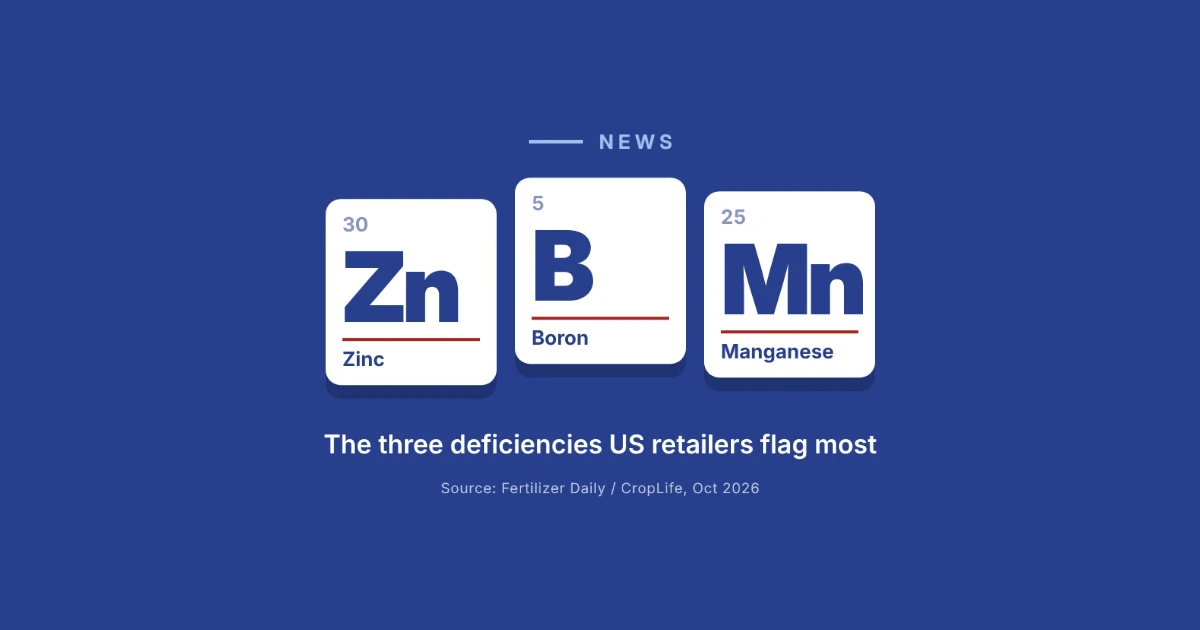
Retailers in the United States report that growers are trimming micronutrient spending this season, while tissue tests keep finding zinc, boron and manganese shortages. At Van Polder, we believe this is the wrong place to save, and the lesson applies to every market our partners serve. When nitrogen, phosphate and potash bills rise, micronutrient fertilizer […]
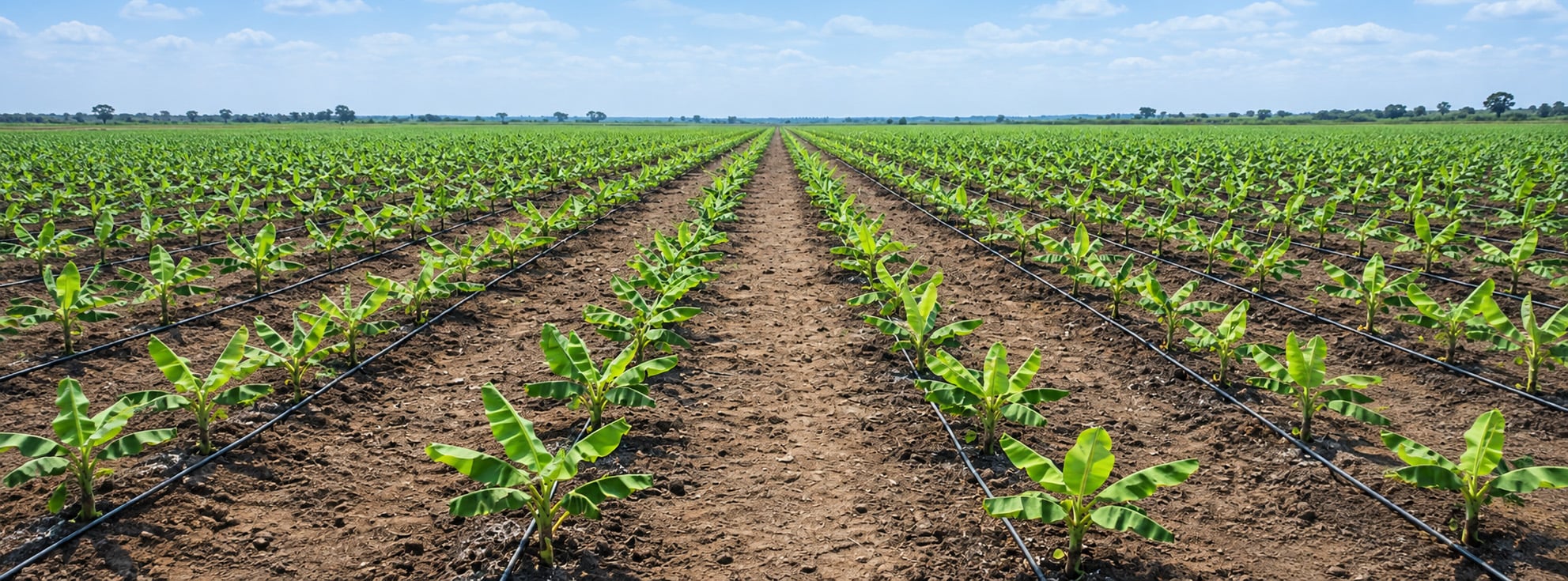
Water-soluble fertilizer for banana lets you feed the crop through drip in small doses that follow each growth stage, and in trials this gave more fruit from less fertilizer and water than soil-applied fertilizer. The best water-soluble fertilizer for banana is the one that dissolves cleanly in your water, matches the growth stage and costs […]
To increase banana bunch weight, build a large, healthy leaf canopy and good potassium reserves before the bunch emerges, keep water supply steady, and protect the leaves until harvest. Most of the bunch’s potential is set before shooting: the number of fruits depends on the leaf area the plant has when it initiates its flower […]
The right fertilizer for banana plants is the one that matches what the crop removes, what your soil already holds and the stage the plant is in. Banana takes up far more potassium than any other nutrient, followed by nitrogen and calcium, so K supply and timing decide much of the result. This guide covers […]
Potassium fertilizer replaces the potassium (K) your crop takes from the soil faster than the soil can release it. After nitrogen, potassium is the nutrient plants need in the largest amounts (Zörb et al., 2014), mainly to move water and sugars and to keep their cells working under stress. The common sources (muriate of potash, […]