







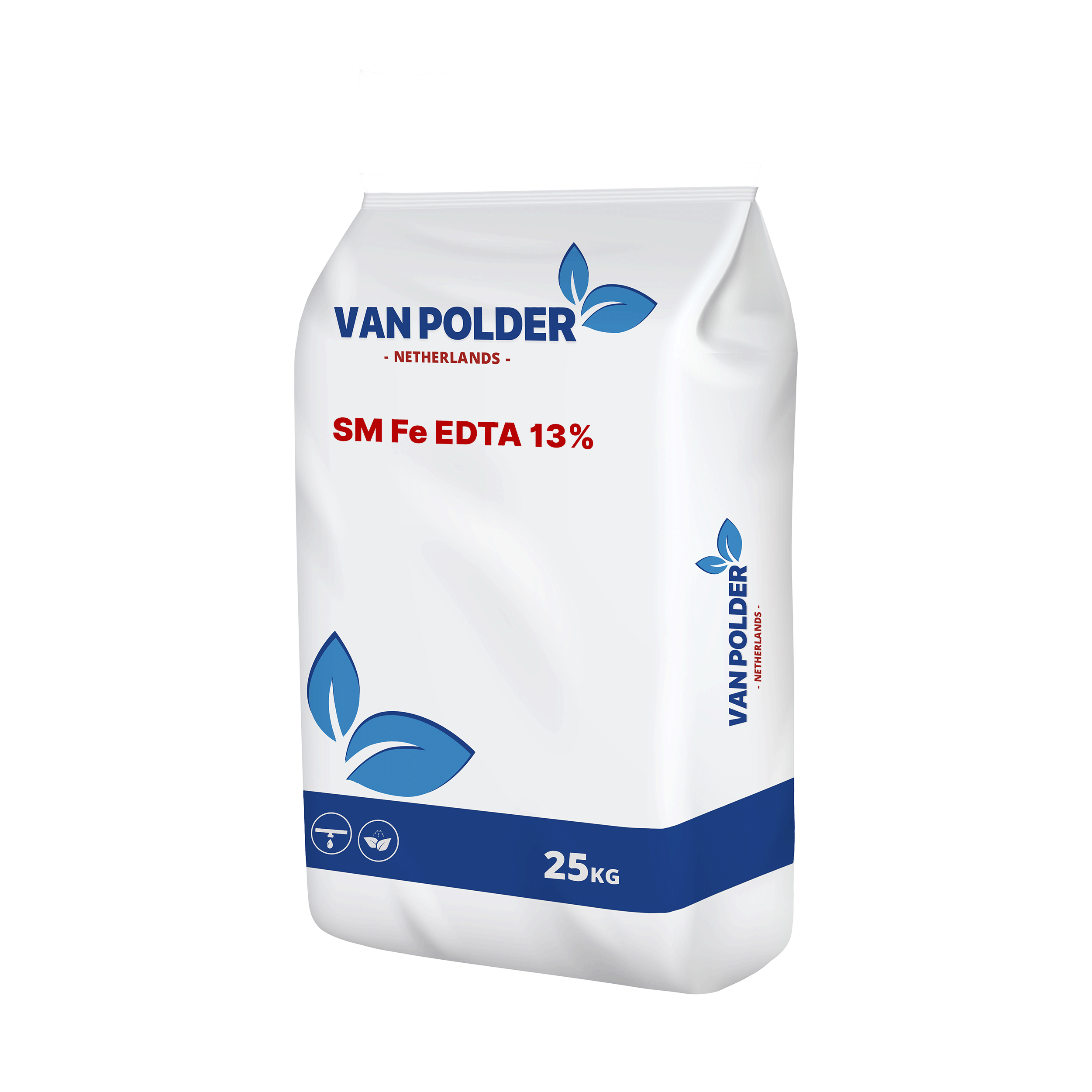
SM Fe EDTA 13%
| FUNCTIONS: | Iron deficiency correction – Chlorophyll formation – Photosynthesis support – Sodium-free nutrition – Foliar and fertigation feeding |
| FOR: | All agricultural and horticultural crops on neutral to slightly acidic soils, including protected and open-field vegetables, fruit, ornamentals, hydroponic and substrate systems, and salinity-prone sites |
| SOURCE: | Synthetic |
| APPEARANCE: | Free-flowing micro-granules, dust-free, non-hygroscopic |
| COLOR: | Yellow to yellowish-brown |
| PACKAGING: | 25 Kg |
SPECIFICATION |
W/W |
|---|---|
| CAS Number | 15275-07-7 |
| Chemical name | Potassium ferric ethylenediaminetetraacetate (potassium ferric EDTA) |
| Chemical formula | C10H12FeKN2O8 |
| Molecular weight | 383.15 g/mol |
| Iron (Fe) | 13% |
| Chelated form | 100% chelated by EDTA |
| pH Stability Range | 4 - 7 |
| Solubility (water, 20 °C) | 600 g/L |
Description
SM Fe EDTA 13% supplies iron in a fully EDTA-chelated form, the nutrient most often locked away from roots even when it is abundant in the soil. Iron turns insoluble as Fe3+ in aerated, alkaline, or bicarbonate-rich conditions, which is why interveinal chlorosis on young leaves is one of the most common micronutrient disorders in the field and in hydroponics. By holding the entire 13% iron content in a soluble chelate, the product delivers the element in a form the plant can absorb and use, and it integrates into foliar sprays, fertigation lines, and nutrient solutions on neutral to slightly acidic soils. The chelate is built on potassium rather than sodium, so it dissolves freely, adds no sodium to the tank or root zone, and balances its structure with a nutrient the plant can use.
Key Benefits
- Corrects iron chlorosis at the source. It delivers iron already protected in a soluble chelate, so the element reaches leaf and root in the form the plant can absorb rather than reverting to the insoluble Fe3+ compounds that cause interveinal yellowing.
- Restores chlorophyll and photosynthesis. Iron is essential to chlorophyll biosynthesis and to the cytochromes and oxidative enzymes that drive respiration and photosynthesis, so correcting a shortfall returns green colour and photosynthetic capacity to new growth.
- Stays available in hard water and moderate pH. The EDTA ring keeps iron in solution through the moderate pH range of most foliar tanks and fertigation water, resisting the precipitation that wastes non-chelated sources.
- Feeds clean, sodium-free nutrition. The potassium-based chelate carries no sodium, and the production route uses no sulphates, chlorides, or nitrates, so iron is corrected without sodium build-up or salinity load, which matters most in greenhouses, substrate, and hydroponic systems and on salt-affected soils.
- Built on a plant-available potassium chelate. The counter-ion that balances the chelate is potassium, a nutrient the crop can use, rather than the inert sodium of ordinary iron chelates, and the potassium form is highly water-soluble, dissolving cleanly at high concentration for reliable spraying and injection.
How It Works
Micronutrient deficiency in the field is usually a problem of availability, not true scarcity. Once a metal cation such as iron, manganese, zinc, copper, magnesium, or calcium enters the soil or hard irrigation water, it reacts readily with hydroxides, carbonates, and phosphates to form compounds the root cannot absorb, so visible deficiency can appear even where the element is physically present. EDTA chelation answers this directly: the chelating agent wraps the metal in a stable ring that keeps it soluble and shields it from those reactions, holding the nutrient in a form the plant can take up. EDTA maintains this protection across moderate pH conditions, which makes it well suited to foliar sprays, hydroponic solutions, and fertigation on neutral to slightly acidic soils.
In SM Fe EDTA 13%, the full declared content of the element is chelated, so every unit applied is delivered in the available, root-ready form rather than as a simple salt that can revert to an insoluble compound. The micro-granules are fully water-soluble and dissolve cleanly without residue, and because the production route uses no sulphates, chlorides, or nitrates, the material introduces no unwanted accompanying anions into the tank or the root zone. The outcome is a clean, predictable correction in which the deficient element reaches the crop quickly, whether the aim is preventing a shortfall before symptoms emerge or correcting one already visible.
When to Use SM Fe EDTA 13%
Apply preventively where iron chlorosis is likely, or correctively at the first sign of interveinal yellowing on young leaves.
- SM Fe EDTA 13% suits early vegetative growth, when rapid new-leaf expansion raises iron demand and chlorosis first appears.
- It fits fruit and vegetable crops through active growth and canopy development, where sustained photosynthesis depends on adequate iron.
- It integrates into hydroponic and fertigation programmes as a continuous iron source on neutral to slightly acidic systems.
Iron deficiency is driven more by availability than by soil iron content, so the chelate matters most where high pH, free lime, bicarbonate, or aeration would otherwise pull iron out of solution before the root can reach it.
On strongly alkaline or calcareous soils, where iron is held above the EDTA stability window, an EDDHA-chelated grade keeps iron available where EDTA cannot.
Because the chelate is sodium-free, it is well suited to greenhouse, substrate, and hydroponic production and to salinity-prone soils, where avoiding sodium accumulation is a priority.
Confirm compatibility with a small-scale jar test before combining with other inputs in the same tank.


saleen

Download product document
Enter your informations to receive the product document by email.t
Monoammonium Phosphate MAP 12-61-0 is a defined mineral salt that dissociates cleanly into ammonium and dihydrogen phosphate ions, delivering a very high 61% P2O5 alongside 12% ammoniacal nitrogen in a fully water-soluble, chloride-free form. The ammonium fraction lowers pH in the immediate root zone as it nitrifies, which improves the availability of phosphorus and other […]
Monopotassium Phosphate MKP 0-52-34 is a defined mineral salt that dissociates into dihydrogen phosphate and potassium ions, delivering a high 52% P2O5 and 34% K2O with no nitrogen and no chloride. Carrying both nutrients without a nitrogen load, MKP supplies phosphorus and potassium exactly when a crop needs them most, at bloom, fruit set, and […]
NPK 30-10-10+TE concentrates its analysis on nitrogen, most of it in urea form, to fuel the rapid leaf and shoot growth of the vegetative phase. Alongside the 30% nitrogen it carries a background of phosphate and potassium, 2% magnesium (MgO) for chlorophyll, and an EDTA-chelated micronutrient package. Fully water-soluble, it dissolves to a clear solution […]
TERRA FUL is the base fulvic acid conditioner in the TERRA range, with no added rooting hormone. It carries 52% organic matter with 38% as fulvic acid and 4.5% water-soluble potassium (K2O), together with organic nitrogen in amino-acid form. Its fulvic acid and organic acids are naturally present in vinasse, a byproduct long documented as […]