







MICROMIX COMBI
| FUNCTIONS: | Micronutrient correction – Deficiency prevention – Chlorophyll formation – Enzyme activation – Foliar nutrition |
| FOR: | Fruit, open-field and protected vegetables, ornamentals, and field crops on neutral to acidic soils that need a complete, evenly available micronutrient correction in foliar or fertigation programs |
| SOURCE: | Synthetic |
| APPEARANCE: | Free-flowing micro-granules, dust-free, non-hygroscopic |
| COLOR: | Green |
| PACKAGING: | 25 Kg |
SPECIFICATION |
W/W |
|---|---|
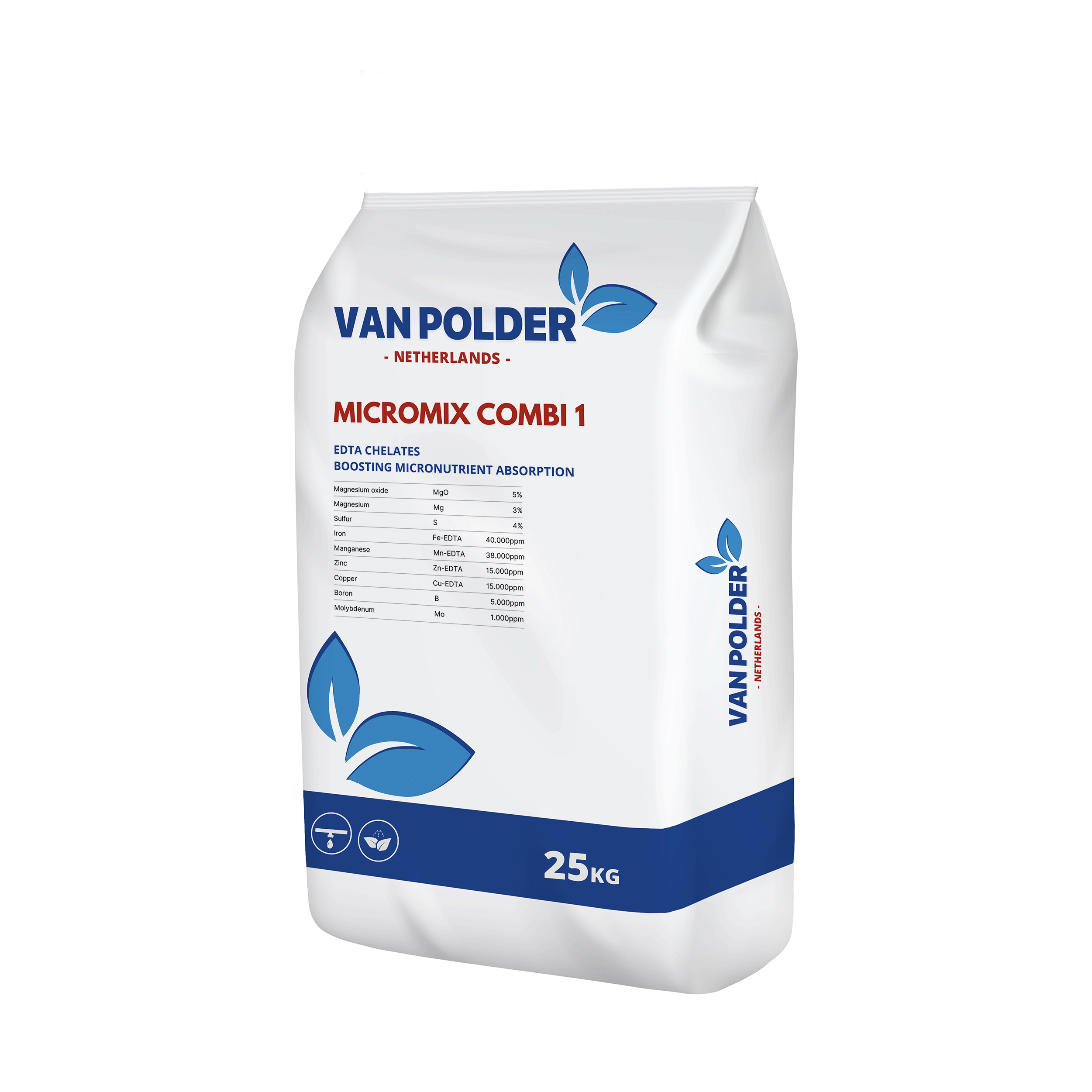
| MICROMIX COMBI 1 | MgO 5%, S 4%, Fe-EDTA 4%, Mn-EDTA 3.8%, Zn-EDTA 1.5%, Cu-EDTA 1.5%, B 0.5%, Mo 0.1% |
| MICROMIX COMBI 2 | Fe-EDTA 7.2%, Mn-EDTA 3.6%, Zn-EDTA 1.2%, Cu-EDTA 0.9%, Mo 0.6% |
| MICROMIX COMBI 3 | Fe-EDTA 4.0%, Mn-EDTA 3.0%, Zn-EDTA 4.0%, Cu-EDTA 0.6%, B 1.5%, MgO 1.1%, Mo 0.05% |
| MICROMIX COMBI 4 | MgO 5.5%, S 5.5%, Fe-EDTA 3.5%, Mn-EDTA 3.0%, Zn-EDTA 2.5%, Cu-EDTA 1%, B 1%, Mo 0.1% |
| MICROMIX COMBI 5 | MgO 10%, S 8.3%, Zn-EDTA 4.5%, Fe-EDTA 2.5%, Cu-EDTA 0.5%, B 1.5% |
| MICROMIX COMBI 6 | MgO 8.5%, S 9%, Fe-EDTA 4%, Mn-EDTA 4.4%, Zn-EDTA 1.5%, Cu-EDTA 1.5%, B 0.5%, Mo 0.1% |
Description
MICROMIX COMBI delivers the full set of crop micronutrients, iron, manganese, zinc, copper, boron and molybdenum, in EDTA-chelated microgranule form, with several grades adding a magnesium and sulphur base. Each grade is a compound microgranule rather than a physical blend of separate single-nutrient particles: every granule carries the complete nutrient set in fixed ratio, so the product cannot segregate in the bag and every dose dissolves to the same uniform, fully balanced feed. The chelated metals stay soluble and root-available through the neutral-to-acidic pH range where this chemistry works best, so a broad or mixed deficiency is corrected in a single product rather than element by element. The range runs from a balanced full-spectrum grade to grades weighted toward iron, zinc, or a heavier magnesium and sulphur base, letting the buyer match the formulation to the deficiency in front of them. The microgranule takes up water readily and goes fully into solution, giving accurate dosing and a clean feed for foliar micronutrient sprays and fertigation across horticulture.
Key Benefits
- Corrects and prevents micronutrient deficiency in available form. MICROMIX COMBI supplies the crop micronutrients together, so a broad or mixed shortfall is addressed in one application. The EDTA-chelated metals resist tie-up in the tank and at the leaf or root surface, keeping the set usable rather than slipping into a hidden deficiency.
- Supports chlorophyll formation and photosynthesis. Iron and manganese are required for chlorophyll synthesis and the photosynthetic apparatus, so correcting their shortfall restores leaf colour and assimilation in the newest growth, where interveinal chlorosis appears first.
- Activates the enzyme and reproductive systems. Zinc drives enzyme function and auxin synthesis, copper supports lignification and respiration, boron underpins cell wall integrity and pollen viability, and molybdenum is needed for nitrate reduction, each a distinct process kept running.
- Adds a magnesium and sulphur contribution on the based grades. Several grades carry a magnesium and sulphur base alongside the micronutrients: magnesium as the central atom of the chlorophyll molecule and sulphur in amino-acid and protein metabolism, a secondary-nutrient layer behind the correction.
- Delivers a uniform feed from a compound microgranule. Because every granule contains the whole nutrient set in fixed ratio rather than being a mix of separate single-element particles, the product does not segregate during handling and each metered dose dissolves fully to the same complete, evenly balanced feed. The microgranule meters reliably and leaves no residue, which suits the range to precise foliar micronutrient work and clean fertigation.
How It Works
A micronutrient cation such as iron, manganese, zinc or copper is readily lost to the plant in soil or hard water: it reacts with carbonates, phosphates and hydroxides to form compounds the root cannot absorb, which is why chlorosis is usually a problem of availability rather than a true scarcity of the element. Iron is the clearest case, since plants take up only the ferrous form and normal soil reactions oxidise added iron to the unavailable ferric form within hours. EDTA is a chelating ligand that wraps each metal in a stable ring, holding it soluble and protected until the plant takes it up. Across the MICROMIX COMBI range the iron, manganese, zinc and copper are EDTA-chelated, while boron and molybdenum, which are taken up as anions and are not ring-chelated, are supplied in fully water-soluble form.
EDTA holds its metals stable across roughly pH 4 to 7, which is why the range is positioned for foliar use and for fertigation on neutral-to-acidic soils; above about pH 7 calcium, magnesium and bicarbonate begin to displace the metal from the ring, and for strongly calcareous soils a stronger chelate such as EDDHA is the right tool for iron. Once absorbed, each element runs its own job: iron and manganese in chlorophyll and the electron-transport chain, zinc in enzyme and hormone synthesis, copper in lignin formation and respiration, boron in cell walls and reproductive tissue, and molybdenum in nitrate reduction. Where a grade carries a magnesium and sulphur base, that fraction runs alongside as a secondary-nutrient supply rather than as part of the chelated micronutrient delivery.
Choosing the Right Grade
All six grades share the same EDTA-chelated chemistry and mode of action; they differ in which micronutrient is weighted and whether they carry a magnesium and sulphur base. Match the grade to the deficiency in front of you.
MICROMIX COMBI range — grade comparison
Guaranteed analysis (%). Fe, Mn, Zn and Cu are EDTA-chelated and water-soluble; B and Mo are water-soluble. All grades are buffered to pH 5.
| Nutrient (%) | COMBI 1 | COMBI 2 | COMBI 3 | COMBI 4 | COMBI 5 | COMBI 6 |
|---|---|---|---|---|---|---|
| Micronutrients | ||||||
| Fe-EDTA | 4.0 | 7.2 | 4.0 | 3.5 | 2.5 | 4.0 |
| Mn-EDTA | 3.8 | 3.6 | 3.0 | 3.0 | – | 4.4 |
| Zn-EDTA | 1.5 | 1.2 | 4.0 | 2.5 | 4.5 | 1.5 |
| Cu-EDTA | 1.5 | 0.9 | 0.6 | 1.0 | 0.5 | 1.5 |
| B | 0.5 | – | 1.5 | 1.0 | 1.5 | 0.5 |
| Mo | 0.1 | 0.6 | 0.05 | 0.1 | – | 0.1 |
| Secondary nutrients | ||||||
| MgO | 5.0 | – | 1.1 | 5.5 | 10.0 | 8.5 |
| S | 4.0 | – | – | 5.5 | 8.3 | 9.0 |
A dash (–) indicates the element is not present in that grade. Figures are nominal guaranteed-analysis percentages.
- MICROMIX COMBI 1. Balanced full-spectrum micronutrients on a magnesium and sulphur base. The general-purpose grade for broad or mixed deficiency and routine correction.
- MICROMIX COMBI 2. Iron-led, with no magnesium or sulphur base. Carries the highest iron loading, for crops where iron-driven interveinal chlorosis is the limiting problem.
- MICROMIX COMBI 3. Iron and zinc co-weighted with a higher boron loading and only a trace of magnesium. For a paired iron and zinc shortfall and crops where reproductive-stage boron matters.
- MICROMIX COMBI 4. Full-spectrum on a substantial magnesium and sulphur base. A maintenance grade for crops that want the complete set with a fuller secondary-nutrient contribution.
- MICROMIX COMBI 5. Zinc-led on the heaviest magnesium and sulphur base, without manganese or molybdenum. For zinc-responsive crops such as maize and cereals where zinc is the priority.
- MICROMIX COMBI 6. Full-spectrum on the highest sulphur base in the range, with a strong magnesium contribution. For a complete correction paired with a meaningful sulphur and magnesium lift.
When to Use MICROMIX COMBI
Apply at the points in the cycle where micronutrient demand is highest or a shortfall is visible, with the grade chosen to fit the deficiency.
- Use MICROMIX COMBI preventively during yield-determining periods and phases of strong vegetative growth, when micronutrient demand peaks.
- Apply it as a corrective treatment when interveinal chlorosis or other early deficiency symptoms appear in the youngest leaves.
- Reach for a balanced grade for a broad shortfall, and a weighted grade where leaf or soil analysis points to a specific element.
- Fit it into routine foliar micronutrient sprays and fertigation cycles on fruit, vegetables, ornamentals and field crops.
Micronutrient availability falls fastest under high-pH or high-bicarbonate conditions and on soils where metals tie up quickly, which is exactly when a chelated, protected supply does the work that a sulphate salt cannot; on strongly calcareous soils an EDDHA-based iron is the more stable choice.
Do not tank-mix with strongly alkaline products or with products that themselves contain metallic elements such as copper or manganese, as these can destabilise the chelate; avoid combining several crop-protection products in one mix. Where any doubt exists, run a small jar test first to confirm compatibility before mixing a full batch.


Anthony Nguyen


Download product document
Enter your informations to receive the product document by email.t
Monoammonium Phosphate MAP 12-61-0 is a defined mineral salt that dissociates cleanly into ammonium and dihydrogen phosphate ions, delivering a very high 61% P2O5 alongside 12% ammoniacal nitrogen in a fully water-soluble, chloride-free form. The ammonium fraction lowers pH in the immediate root zone as it nitrifies, which improves the availability of phosphorus and other […]
Monopotassium Phosphate MKP 0-52-34 is a defined mineral salt that dissociates into dihydrogen phosphate and potassium ions, delivering a high 52% P2O5 and 34% K2O with no nitrogen and no chloride. Carrying both nutrients without a nitrogen load, MKP supplies phosphorus and potassium exactly when a crop needs them most, at bloom, fruit set, and […]
NPK 30-10-10+TE concentrates its analysis on nitrogen, most of it in urea form, to fuel the rapid leaf and shoot growth of the vegetative phase. Alongside the 30% nitrogen it carries a background of phosphate and potassium, 2% magnesium (MgO) for chlorophyll, and an EDTA-chelated micronutrient package. Fully water-soluble, it dissolves to a clear solution […]
TERRA FUL is the base fulvic acid conditioner in the TERRA range, with no added rooting hormone. It carries 52% organic matter with 38% as fulvic acid and 4.5% water-soluble potassium (K2O), together with organic nitrogen in amino-acid form. Its fulvic acid and organic acids are naturally present in vinasse, a byproduct long documented as […]